|
|
Penarth Dock, South Wales - the heritage & legacy . . . |
|
|
Penarth Dock, South Wales - the heritage & legacy . . . |
| Volume One - Into the Victorian Age - The construction of the dock . . . |
 |
|
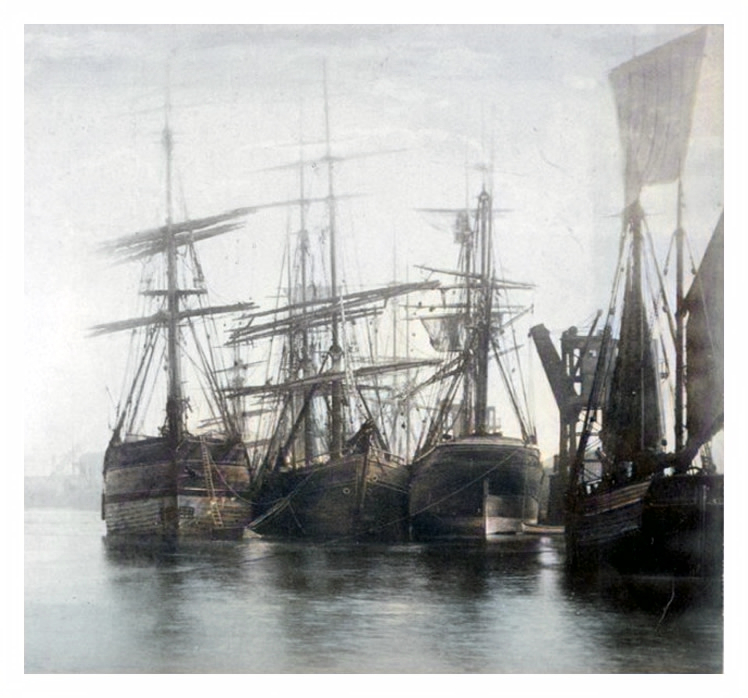
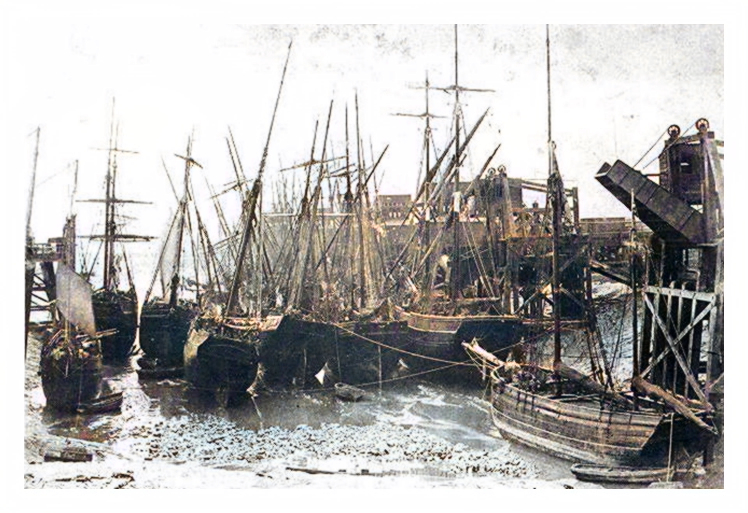
The export of coal was well established by 1860. The Rivers Ely and Taff, are a hive of activity as the above image indicates with its schooners, brigs and ketches, wall to wall across the river, awaiting the next tide. There were at least 10 coal tips in the River Ely by this date together with steam driven cranes to assist the removal of ballast. The ballast was required in the ship's hold to ensure that the ship remained stable and in-trim in heavy seas especially when unladen or lightly laden. The first job when a ship arrived was to unload the ballast before loading coal could commence. The problem with a tidal dock is that if the ship was delayed there was a possibility that as the tide receded it would ground on the mud and be swamped on the next incoming tide. Another danger was that the ship could become unstable as the tide receded due to the U shaped cross-section of the river. If the ship was poorly trimmed when loading coal it could topple over. The third possibility, especially a problem at Newport tidal dock, known as the graveyard for ships, was that the ship settled its keel onto a trough or slough and simply broke its back due to the unsupported mass of coal in its hold. These were wooden ships with loads of several hundred tons of coal when laden. These were testing and nervous times for the crew indeed and even before putting to sea! [025] Even the Bute Docks were congested as the image below indicates. [000] [002] On 8th October 1859 the Cardiff Times [019] reported: "Trade at the Harbour. - This place of business is now getting into work, and the arrangements are being completed by which cargoes of coal of considerable importance are being shipped there. Unquestionably it will become a place of much business in the course of a few years, but very shortly the merchants who have business premises at the Bute Docks (Cardiff) will find the inconvenience attending the mode of communication between the docks and Penarth harbour." The same newspaper provided a summary in 1865: "A contract was entered into with Messrs. Rennie and Logan, (Minutes of the Board name the contractor as Rennie & Company) who proceeded rapidly to construct a railway and tidal harbour, which were opened for traffic in 1858. The railway both to the harbour and the dock are carried on an embankment for the greater part of its length. The materials for constructing this embankment were furnished by the excavations for the intended dock. The effect of the expense gone into forming the embankment has been to secure the railroad unusually good gradients, the line being practically level, and therefore capable of carrying the heaviest loads at the smallest cost, a great advantage to any line, but most of all to a mineral railway. The tidal harbour has ten coal drops, each capable of shipping 150 tons per hour. This number may be doubled if necessary. There are also three steam ballast cranes for discharging ballast and iron ore, each of which is capable of discharging at the rate of sixty tons an hour." Cardiff Times [019] 9th June 1865. Tenders were invited on the 24th October 1856 for the building of a railway and harbour on the banks of the river Ely. By 1st December 1856, 8 tenders had been submitted and the tender from Mr James Rennie at £92,529 was amended and approved by the directors. It was expected that the works would be completed by the 30th June 1858. [063] The Minutes [701] of the Board Meeting of the Ely Tidal Harbour & Railway Company record : - 1.12.1856 : Mr. Rennie having offered to execute the works at £91,000 if excavations taken from soite [sic. ? site] for Dock, or at £81,000 if excavation not required to be so taken. |