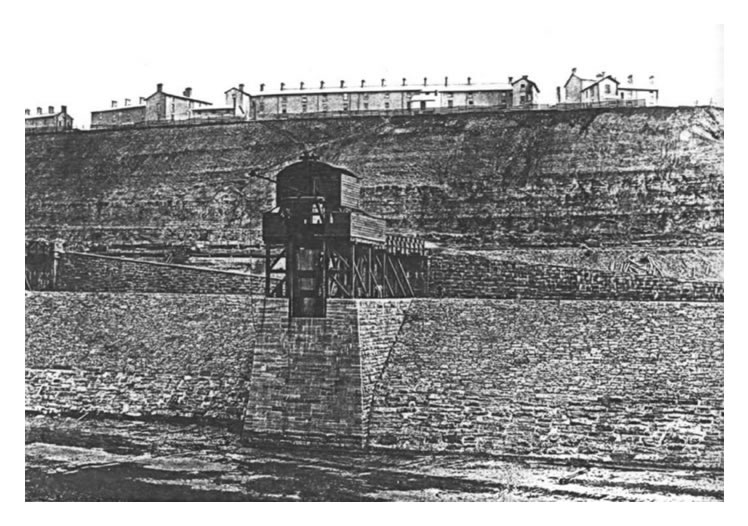
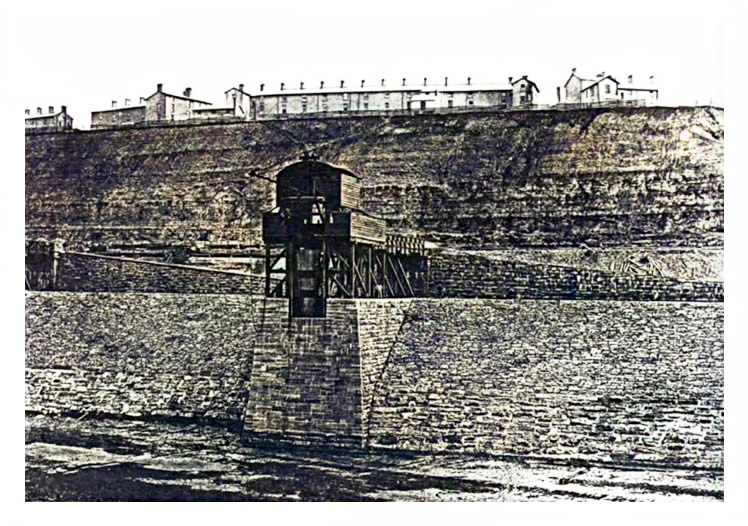
In the lower image we see the 'naked' dual tips numbers 2 and 3 i.e. minus their wooden housing. This image therefore, is from a slightly earlier date than the image above. Much of the ironwork and hydraulic equipment for the tips was supplied by W. A. Armstrong, the armaments manufacturer from Newcastle-upon-Tyne. The coal tips had a capacity of 150 tons per hour per tip and were only partially hydraulically operated. The hydraulic house was situated on the other side of the dock so, in order to feed the entire hydraulic system long runs of pipework were necessary. In winter months these were prone to freezing up so fires would be lit adjacent to the pipework etc. I bet the fires warmed many shunters, tippers, trimmers and hobblers as well!
Three men and a boy operated each of the tips. The 6 ton capacity coal wagons ran by gravity onto the turntable at the rear side of the tips where they could be orientated correctly ensuring that the opening flap at the end of the wagon faced the dock. Then the wagon was run onto the cradle within the tip structure, lifted to an appropriate height for entry to the chute using hydraulic power. Attached to the rear of the wagon was a hook and a lifting chain tipped the wagon permitting coal to exit the flap, down the chute and into the hold of the ship where the hobblers and trimmers were waiting to distribute the coal evenly. The empty wagon, complete with the cradle was counterbalanced, and lifted to the higher level, where the wagon was discharged from the tip back to the sidings for reconnection to a train and the return journey to the colliery.
The houses at the skyline in both images are the backs of the houses of Maughan Street, the houses fronting Paget Road, which was still named Dock Road on the 1915 OS map, having not yet been constructed. The lower images in each case have been colourised. [009] [007]