 |
 |
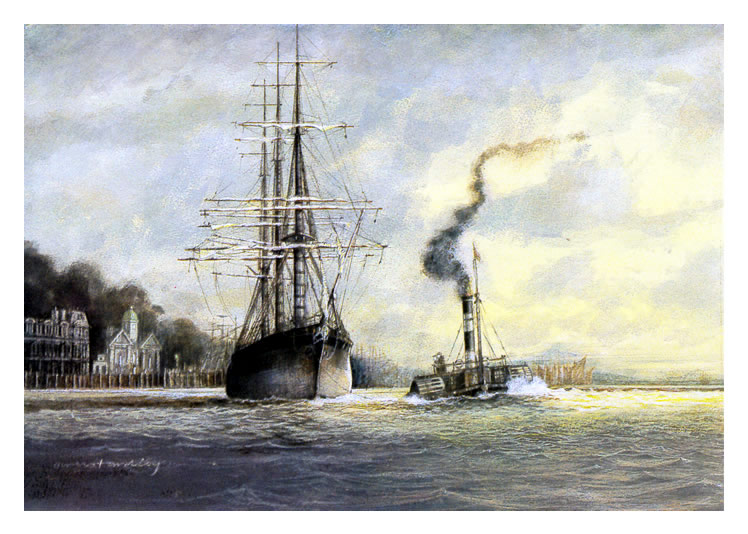
1886 - The s.s. "Great Britain" under tow, outbound from Penarth Dock on the 6th February 1886, leaving behind the distinctive Mercantile Marine Offices and Customs House. At the time she was the largest ship in the World at 322 ft (98m) from stem to stern. She was launched at Bristol on the 19th July 1843. The artist was Owen Eardley. [044]
She was primarily a steamship with sail assist and had a displacement of 3,675 tons. I recall seeing her on a barge being towed up the Bristol Channel back in July 1970. It is well worth a trip to Bristol to see her restored in the original dock where 'Mr. B' built her. [001]
|
| |
 |
The 'Great Britain' off Lundy Island from the Illustrated London News published during February 1845. [121] |
| |
 |
Whilst visiting Penarth during June 2016, Julie called in to send my regards to Villis at Penarth Framing Services and purchased a print of 's.s. Great Britain leaving Penarth - 6th February 1886' by the fine maritime artist Tony Batey. [402] It captures the essence of her departure admirably as she passes the dock entrance beyond the Customs House and Dock Offices on her last voyage (for some time!). Copies of the print are available from Penarth Framing Services. [001] [113] |
| |
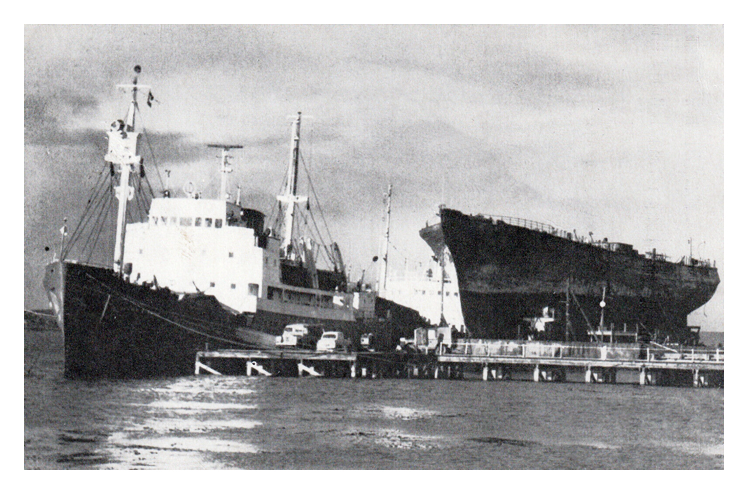 |
1970 - S.S. Great Britain - At Port Stanley prior to departure for the U.K. - Published by the S.S. Great Britain Project and Printed by Gale & Polden Ltd., Aldershot. Another heritage postcard held within the Penarth Dock Collection. [001]
The Falklands Maritime Heritage Trust commented that : On 7th April 1970, she was refloated and began an 8,000-mile journey back to Bristol, where she arrived on 19th July 1970, 127 years after she was launched, to be restored to her former glory at a cost of £11.3 million and become the museum ship she is today in the Great Western Dockyard. Brunel’s Great Iron Ship was hailed as “The Grand Old Lady”. |
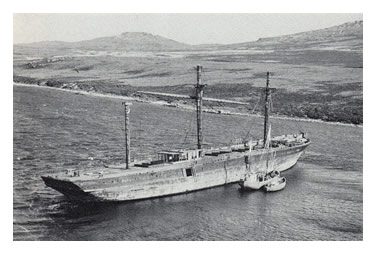 |
1964 - A photograph taken aboard H.M.S. Protector of the 'Great Britain' as a hulk in the Sparrow Cove of the Falkland Islands. [1295] |
| |
 |
A postcard view of the s.s. 'Great Britain' transatlantic liner of 1843 back in the Great Western Dock at Bristol following her recovery from Sparrow Cove with renovation in progress. I think my last visit was probably in the 1990's so a revisit is long overdue - maybe I'll see you there! [001] |
| |
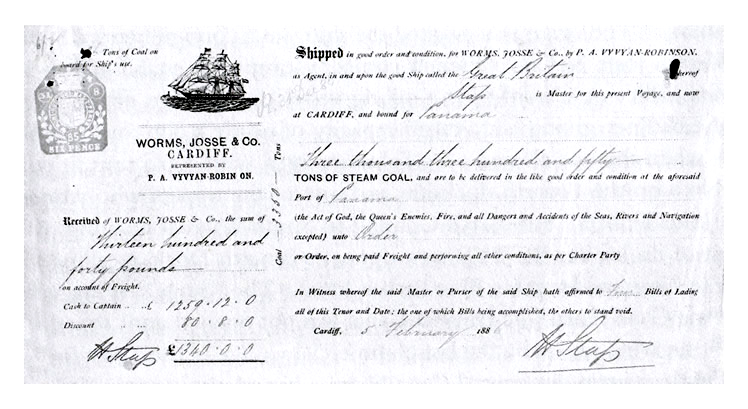 |
The Bill of Lading for 3,350 tons of steam coal loaded aboard the s.s. Great Britain courtesy of Worms, Josse & Co., Cardiff who was represented by P. A. Vyvyan-Robin ON ; the sum of £1,3,40 - 0s - 0d being transacted on the 5th February 1886. The coal was loaded at number 9 tip of Penarth Dock to be delivered to the Port of Panama but it was to be the last cargo to be carried in her hold. [611] |
| |
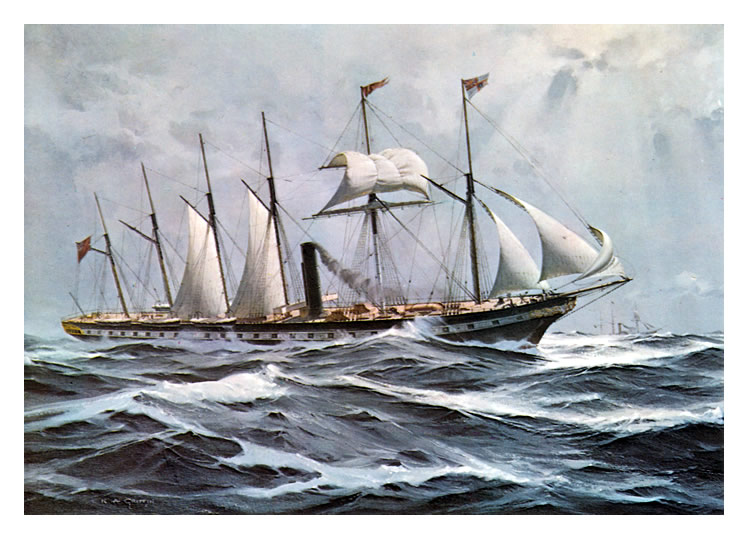 |
s.s. 'Great Britain, 1843' - from a painting by Keith A. Griffin held within the Penarth Dock Collection. [001] [998] [20220409] |
| |
 |
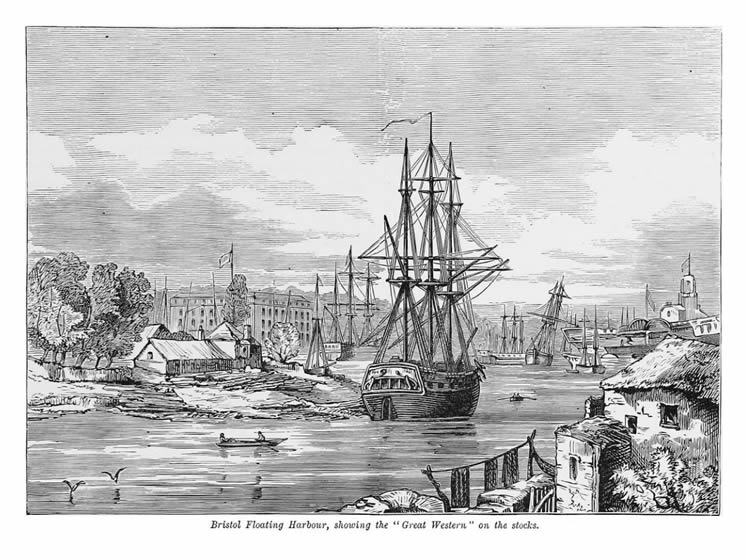 |
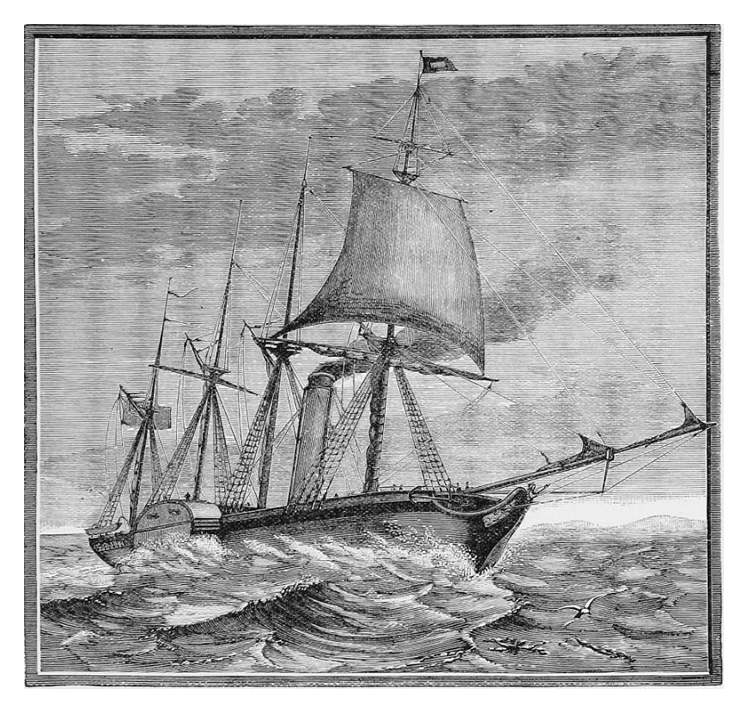
| 1882 - Two interesting illustrations from the book ; 'Bristol : Past and Present' - 'The "Great Britain" Built in Bristol - A.D. 1843' and below, 'Bristol Floating Harbour, showing the "Great Western" on the stocks.' - [1077] [499] |
| |
The following record is taken from 'The Maritime Archaeology of the South Wales Coal Trade Final Report' [1060] [1061] [122]
Launched in 1843, Brunel’s Great Britain was a revolutionary iron-hulled screw steamship, the first ocean-going screw driven vessel. In 1882 the ship, its transatlantic career being long behind it, had its engines removed and it was rerigged as a three-masted fully rigged sailing ship. As such the Great Britain made a number of voyages to San Francisco carrying South Wales coal and returning with grain.
In February 1886 the Great Britain left Penarth with coal bound for the west coast of South America. Rounding Cape Horn, it ran into a hurricane. It was partially demasted, sprang several leaks and, most seriously, the cargo shifted. The vessel was forced to turn around and make a run to the Falkland Islands. It ran aground there but was refloated and towed into Port Stanley. There it was effectively abandoned and used as a hulk until 1970 when it was brought back to the port where it was built, Bristol, and subsequently restored.
In terms of the Welsh coal trade the Great Britain is significant in being a rare example of a preserved foreign-going sailing vessel that regularly carried Welsh coal. This status is enhanced by the fame of the vessel generally and its association with the United Kingdom’s most famous engineer. |
| |
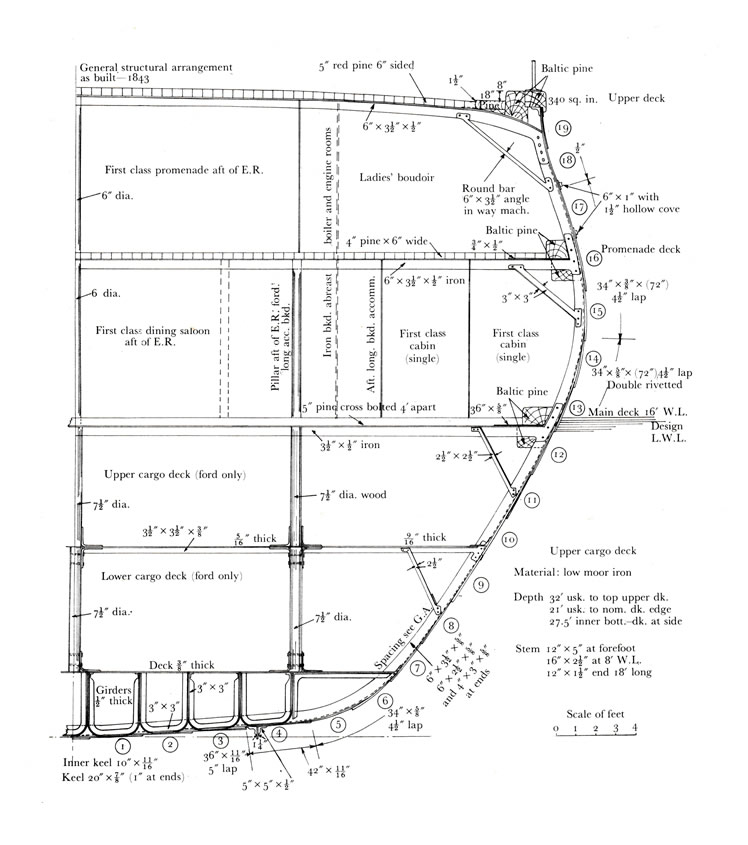 |
| A half-hull, cross-sectional view of the s.s. 'Great Britain' - General structural arrangement as built - 1843 - The structural integrity of the design of Brunel was tested following her stranding in Dundrum Bay for nearly one year being subjected to numerous 'indignities' as one writer put it! Interestingly, the material is defined a low moor iron. [1312] |
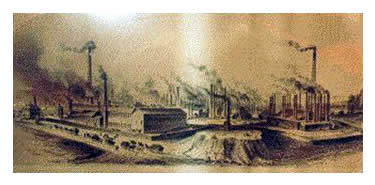
| c.1855 - Low Moor Ironworks, Bradford, West Riding of Yorkshire ; or as the Yorkshire poet, John Nicholson, described the works and wrote of it in 1829:- |
When first the shapeless sable Ore
Is laid in heaps around Low Moor,
The roaring Blast, the quiv’ring Flame,
Give to the mass another name;
White as the Sun the Metal runs,
For Horse Shoe Nails, or thund’ring Guns;
The trembling hair-spring of a Watch,
An Anchor, or a Cottage latch –
Most implements the Farmers have,
And those of Steamers on the wave
The Tailor’s Needle, or the Shell
The levell’d once where Princes dwell;
The Engine, Boiler, Cobler’s awl,
The Carronade, the pond’rous ball;
The place where Steam first moved his wings,
The Nails in Beggars’ Shoes and Kings’;
The Anchor’s Chain, the Fisher’s Hook,
The Sword – the Hatchet – and the Crook,
The sounding Anvil, all the blades,
The cause of many thousand trades;
No pen can write, no mind can soar
To tell the Wonders of Low Moor.
|
 |
| |
|
