|
|
Penarth Dock, South Wales - the heritage & legacy . . . |
|
|
Penarth Dock, South Wales - the heritage & legacy . . . |
 |
|||||
 |
Volume One - Into the Victorian Age - The Penarth Dock and Harbour in 1896 . . The Dock gates and bridges are opened and closed by hydraulic power, and eight hydraulic capstans are provided at the outer and inner gates to assist vessels passing in and out of Dock. There are fourteen high level coal shipping staiths on the Dock and two on the Basin, some of which are double or twin staiths. Three have recently been re-constructed with moveable shoots rising to a height of from 50 to 60 ft. above the water line, whereby steamers of the largest class can take in their bunker coal when light without interruption. All the coal staiths are worked by hydraulic power, and are capable of shipping at the greatest possible speed. On one occasion this year no less than 700 tons were shipped into a steamer by one staith in one hour and ten minutes. The staiths are fitted with double screens, and every provision has been made for the shipment of coal with a minimum of breakage. The staiths are equipped with counterbalancing weights so that wagons may, when necessary, be suspended in the butt of the shoot for any length of time thereby enabling the coal to be shipped gradually, and therefore with less breakage.
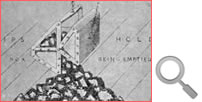
The bucket is divided into two portions, to one of which the handle is rigidly attached in such a manner that the second portion swings freely on a pivot connecting the handle, and the two portions of the bucket together, and is constructed to open along the bottom. The bucket is placed in the ordinary way at the point of the coal shoot, and it is so designed that when being loaded neither the weight nor the thrust of the coal will open the box (although it opens along the bottom), gravity alone suffices to keep the two portions together. When the box is loaded, it is lowered into the vessel's hold and opened automatically by an adjustable tipping chain, and the load gently deposited at the bottom of vessel, thereby securing freedom of breakage of the very friable South Wales coal; the box on being relifted by a hydraulic crane to the point of the shoot closes by its own weight and is ready to be refilled. |
||||
| Introduction | |||||
| Contents | |||||
| Search this site | |||||
| Contributions | |||||
| Links | |||||
| Recent Updates | |||||
|
|||||
| | volume 01 | chapter 16 | page 030 | << previous page << | index to volume one | >> next page >> | | |||||
|
|||||