|
|
Penarth Dock, South Wales - the heritage & legacy . . . |
|
|
Penarth Dock, South Wales - the heritage & legacy . . . |
 |
|||
 |
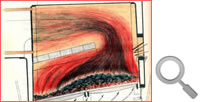
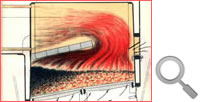
Volume Two - The Era of Optimism, Investment & Development - Penarth's contribution to coal exports . . . The proper method of firing is to fire little and often, especially when using very small coal. To avoid the emission of black smoke from shunting engines, it has been found advantageous to fire alternative sides of the firebox; by this means one half of the fire is kept in a bright state and consumes the smoke emitted from the fire on the other side. Various quantities of air are required according to the thickness of the fire, and should be regulated by manipulating the damper and firehole door. Air will not flow freely through banks in the fire and combustion at these points will not be satisfactory. Large quantities of air will There are certain engines which require firing in a way peculiar to themselves. Some engines with horizontal firebars require a level fire; others require the fire a little thicker at It is inadvisable to commence firing when leaving a station. The Fireman should first satisfy himself that the train is following in a proper manner. When the engine has started the exhaust will begin and liven the fire, which had settled down after the regulator was closed for making the stop, and then is the time to start firing. A distinct advantage is gained by waiting until the engine is notched up, in order that too much cold air is not admitted to the firebox through the firehole door, as would be the case if firing was taking place when the engine was in full travel." |
||
| Introduction | |||
| Contents | |||
| Search this site | |||
| Contributions | |||
| Links | |||
| Recent Updates | |||
|
|||
| | volume 02 | chapter 08 | page 10 | << previous page << | index to volume two | >> next page >> | | |||
|
|||