Penarth Dock, South Wales - 150 years - the heritage and legacy  
Penarth Dock, South Wales - the heritage & legacy . . .

Volume Six - Pre-Victorian to the Present Day - Select Aspects - The subway under the river Ely story . . .

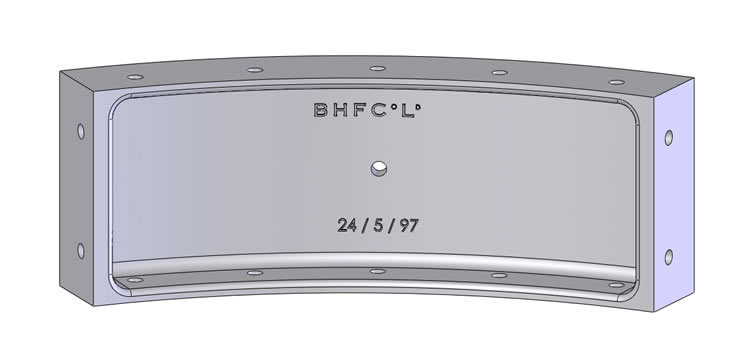
A 3D CAD model of a subway segment
The 3D CAD model of a segment from the subway which if manufactured from a standard grade of grey cast iron would weigh about 300 Kg or 660 lbs each. Imagine handling one of those in the confined conditions within the tunneling shield! And then consider that between ring number 198/199 and ring 596/597 there were 2,779 of them to install. Then on either side, as the forces acting on the subway declined because they were nearer the surface and had less hydrostatic pressure acting on them, the thickness of the segments was reduced from 45 mm to 19 mm there was a similar quantity of the lighter version to install as well. The total weight of the iron segments needed to complete the subway would be approx. 1,500 tons. The hole in the face of the segment was used to fill the cavity left by the Greathead shield. Grout, in the form of cement mixture, is pumped under pressure from the compressed air supply through the hole which has previously been tapped (threaded) and a bolt is simply screwed and tightened into the hole to seal it off. [001] [108]
 
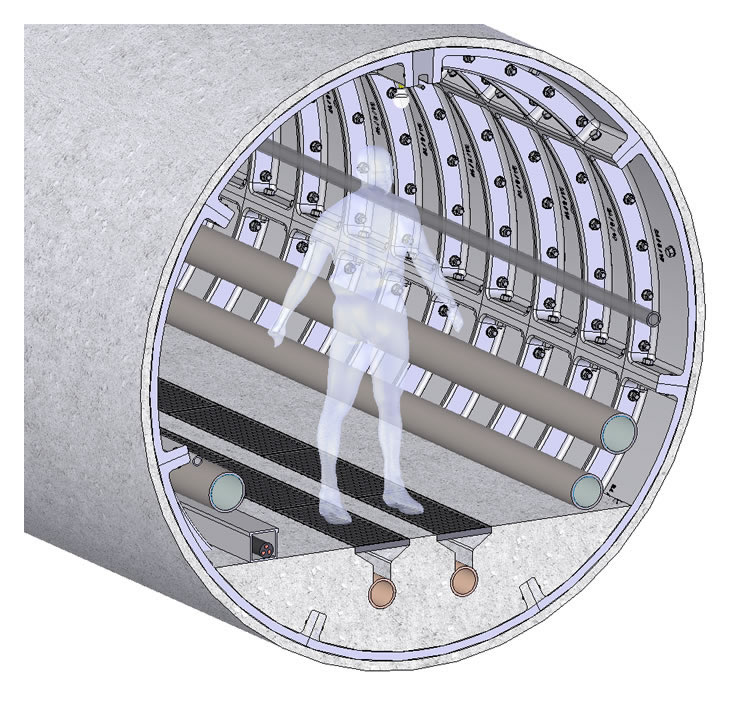
A 3D CAD model of the River Ely subway at Penarth Dock.
An assembly of a section of the subway, again modeled using SolidWorks 3D CAD software. The cross-section provides a good indication of the space in the subway. The floor was concrete but had drainage channels leading to the lowest point where there was a pump to remove water to the surface. The larger pipes on each side were the hydraulic flow and return pipes to provide the power to operate the coal tips on the Ely tidal harbour. On the right hand side below is a water main (or a gas main depending upon who's account you read!) and the square section trunking is a later addition which carried an 11,000 volt power cable for the South Wales Electricity Board which was found to be still live at the time of the survey! Around the outer surface of the cast iron segments there was a gap of about 2" (5 cm) left by the tunneling shield which was pumped full of cement mixture as construction progressed. [001] [108]
© 2014 - 2025 - penarth-dock.org.uk - all rights reserved - web design by Dai the Rat