|
|
Penarth Dock, South Wales - the heritage & legacy . . . |
|
|
Penarth Dock, South Wales - the heritage & legacy . . . |
 |
|||||
 |
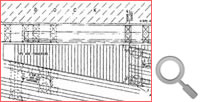
Volume Six - Pre-Victorian to the Present Day - Select Aspects - Mechanical appliances used in the shipping of coal at Penarth Docks - 1906 . . . The only water used to tip the wagon is that which passes into the tipping-ram. The point of the shoot is suspended on chains, and is raised by a small hydraulic-engine fixed on the tip platform. As many as sixty wagons an hour can be tipped at these tips, which are capable of dealing with wagons having a gross weight of 20 tons. The Armstrong tips, No's. 2, 6 and 10, erected in 1893, are capable of tipping wagons at any height between 3 and 37 feet above the quay-level, or 47 feet above the water-level when there is 32 feet depth on dock-cill. The cradle is suspended by four 1⅛-inch diameter chains. The front chains pass over sheaves at the top of the tip and down under the main hoist ram-head, and are made fast to the cylinders ; the two back chains run up to the top of the tip down under the main hoist ram-head and up over the tipping ram-head, and are made fast to the ram cylinder. The hoist-rams are two in number, one 13¾-inches diameter and the other 5½ inches diameter. The tipping ram is 11¾-inches diameter. The two main hoist-rams can be used independently of each other, and it is only necessary to use both rams when the heaviest wagons are tipped. When tipping below the level of the road a balance-weight can be fixed to the main hoist ram-head, the weight being sufficient to return the cradle and empty wagon to the proper height after the wagon has been tipped. When lowering the cradle, the speed is regulated by the exhaust-valve. A small two-cylinder double-acting hydraulic engine is provided for raising the point of the shoot; the butt-end of the shoot is raised by means of the cradle. A 2 ton anti-breakage crane is fixed on these tips. The valves are worked by means of chains which run from the valves up the one side of the tip over the top and down the other side. The operator can stand on a small platform on the cradle or remain on the high-level stage of the tip. These tips can deal with wagons of a gross weight of 22 tons at a high speed.
|
||||
| Introduction | |||||
| Contents | |||||
| Search this site | |||||
| Contributions | |||||
| Links | |||||
| Recent Updates | |||||
|
|||||
| | volume 06 | chapter 08 | page 02 | << previous page << | index to volume six | >> next page >> | | |||||
|
|||||