|
|
Penarth Dock, South Wales - the heritage & legacy . . . |
|
|
Penarth Dock, South Wales - the heritage & legacy . . . |
 |
|||||
 |
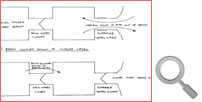
Volume Six - Pre-Victorian to the Present Day - Select Aspects - The Pumping Engine House . . . If the half-tide basin was suitably equipped then vessels could load or discharge all or part of their cargo in the basin without having to wait to enter the main dock.
In its simplest form the half-tide basin acted like a huge lock, however, if the single gates between the basin and the main dock were replaced with two pairs of gates to form a lock then even greater flexibility in the operation of the half-tide basin could be achieved. In this case vessels could enter the main dock immediately upon entering the basin if they required urgent dock facilities. More complicated gate arrangements are possible including a lock between the sea and the basin and in rare cases a lock at the entrance formed by reverse gates and allowing vessels to enter when the water level outside is higher than that in the basin. It is perhaps also worth pointing out that a problem arises in that by continually sluicing the main dock into the basin the level of water in the man dock can become seriously reduced. At Cardiff this was not a problem since water for the docks was continually supplied from the River Taff and the level maintained at a constant depth. However, Penarth Dock had no such supply and instead huge pumps were used to raise the water level within the dock whenever necessary. These pumps were capable of raising the water level over the entire 23 acres at a rate of 1 foot per hour.
|
||||
| Introduction | |||||
| Contents | |||||
| Search this site | |||||
| Contributions | |||||
| Links | |||||
| Recent Updates | |||||
|
|||||
| | volume 06 | chapter 16 | page 080 | << previous page << | index to volume six | >> next page >> | | |||||
|
|||||