|
|
Penarth Dock, South Wales - the heritage & legacy . . . |
|
|
Penarth Dock, South Wales - the heritage & legacy . . . |
 |
|||||
 |
Volume Six - Pre-Victorian to the Present Day - Select Aspects - The Royal Navy and Royal Naval Reserve Fleet at Penarth Dock
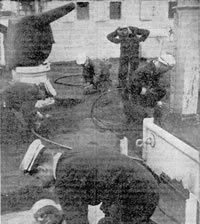
The Royal Navy's tank cleaning fleet consists of R.F.A. Bardsey, H.M. Ships Caldy, Coll and Switha. These ships were converted from Isles class trawlers, the first, Coll, being completed in 1950. Caldy, Coll and Switha are attached to the home dockyard ports of Chatham, Portsmouth and Devonport respectively; Bardsey is stationed at Malta. The first three are administered by the senior officers of the Reserve Fleet at their respective ports, overall control of all four being exercised by the Flag Officer Commanding Reserve Fleet. Only Coll and Switha have been operational in home ports for the last year. Caldy being comparatively new. Despite the fact that both ships have been refitted during this period they have between them visited some 70 ships at different ports, cleaned about 550 oil fuel tanks and 60 bilges. They have recovered approximately 2,500 tons of fuel oil, and used themselves 500 tons, a saving of nearly £14,000 for fuel alone. Since these vessels can clean the fuel tanks of a destroyer in three days or so while using seven senior ratings and eleven junior ratings, the saving to the Service is in the region of 870,000 man-hours annually. Oil tanks to be cleaned are first pumped out to the extent of their fitted suctions. they are then saturated with steam to lower the viscosity of the residue, sometimes of the consistency of asphalt, so that it can easily be gulfed in the airstream of the suction hoses, the velocity of which is supplied by two large vacuum pumps installed in the T.C.V. |
||||
| Introduction | |||||
| Contents | |||||
| Search this site | |||||
| Contributions | |||||
| Links | |||||
| Recent Updates | |||||
|
|||||
| | volume 06 | chapter 18 | page 050 | << previous page << | index to volume six | >> next page >> | | |||||
|
|||||