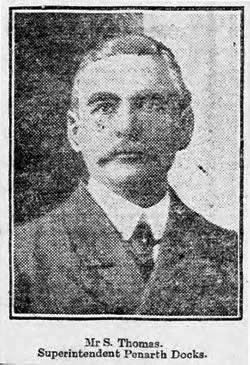
Samuel Thomas was the Superintendent and Dock Master of the Penarth Docks. This photograph appeared within the Cardiff Times in an article about his part in the day to day operation of Penarth Dock which was published on 4th August 1906. [019] I have not been able to discover much more about his life - your assistance would be very welcome. I wonder if he was any relation to my wife Julie, who was a Cogan Thomas, that is, until I came along!
◊ 1892 - Penarth Dock - Appointment of Mr Edwards's Successor - 'At a meeting of the directors of the Taff Vale Railway Company, held on Tuesday, it was decided to appoint Mr Samuel Thomas, collector at Penarth Dock, to the discharge of the duties heretofore entrusted to the late Mr James Edwards. Mr Thomas has, since the death of Mr Edwards, taken charge of the dock, and is, of course, fully conversant with all the details of the business and the practical management of affairs.' - South Wales Daily News - [325] [361] - 29th September 1892.
◊ 1901 - Thomas, Samuel, collector & superintendent Penarth docks, 36 Stanwell road. [175]
◊ 1908 - The Superintendent and Dock Master of the Penarth Docks - 'Mr. Samuel Thomas has been associated with the dock since 1866, the year after it opened. Entering the service of the Company when he was thirteen years of age, he steadily improved his position, and his long and varied experience in the several departments of dock working has proved of great value to the Company. After holding for many years the position of Collector of Dock Dues, he was appointed Superintendent of the Dock and Dock Master in 1894.' - South Wales Coal Annual - 1908 [039]
|
|
In 1914 Samuel Thomas registered a patent relating to docking improvements which was reported in the 'Engineer' of 5th March 1915. [015] [016]
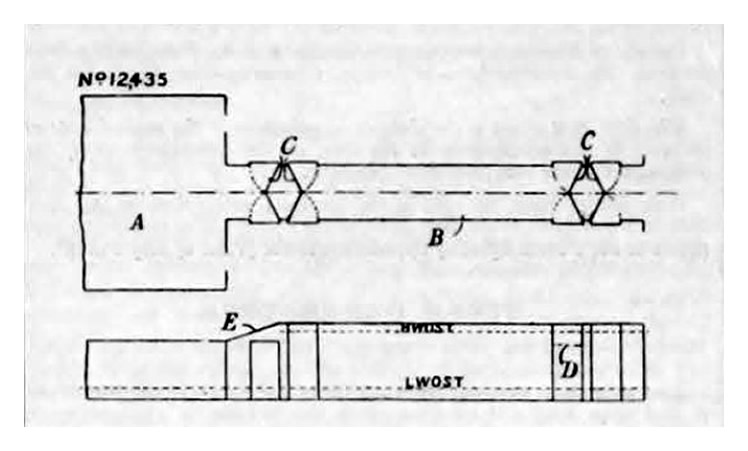
12,435. May 20th, 1914. - Improvements Relating to Docks, Dock Entrances, and Entrance Locks to Docks. S. Thomas and S. H. Thomas, 27, Stanwell-road, Penarth, Glamorgan.
A represents a portion of the dock and B the lock, the latter being preferably of a length suitable for small or medium-sized vessels - that is to say, for the majority of vessels using the dock. large vessels may, however, still enter by selecting a time when they can float straight into the dock, this being possible throughout the year. Two pairs of gates C are provided at each end of the lock so that a level of water may be retained in the dock, lock, or externally of the lock, according to conditions. The inner pair of gates at the dock entrance need only be at the height of the dock walls and of the inner pair of gates at the dock entrance, as shown by the dotted line D.
It will be seen that the bottoms of the dock and lock are at the same level, but that the coping of the dock wall is below that of the lock, the two being connected by the sloping ramp E. The principal advantages obtained are, it is claimed, as follows:- the cost of construction of the entrance works to docks by avoiding the necessity of very long entrance locks suitable for vessels of exceptional size ; reduction in the cost of the dock plant and equipment consequent upon the avoidance of large locks and prolonged pumping operations ; increased facility for to dock and undock vessels on every tide, without necessarily holding them in the lock, or in other words, at some state of the tide throughout the year a level may be obtained from sea to dock, and hence, whether a vessel is too long for the lock or not, it may enter the dock. - February 10th, 1915.
>> Next Page >> |