|
|
Penarth Dock, South Wales - the heritage & legacy . . . |
|
|
Penarth Dock, South Wales - the heritage & legacy . . . |
 |
|||||
 |
Volume Eight - Pre-Victorian to the present day - more aspects - Pamir and Passat - the end of an era . . .
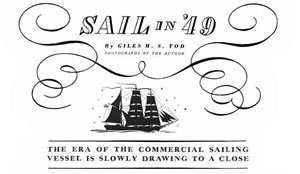
The 2796-ton Pamir, once more under the Finnish flag, had been in Wellington, New Zealand, at the beginning of 1949 making ready for sea. On February 1 she eventually got under way in ballast. Winds were far from favourable at first, and it was all of a fortnight before the needed southerly breeze came. After passing through Cook Strait, she beat her way around the south of Australia to the Spencer Gulf, arriving in Port Victoria on March 7, thirty-four days out. During the next two months 4223 tons of barley in bags was stowed in her hold. Captain Verner Bjorfelt, 49-year old Finn who had the Pamir in 1939, had returned aboard again to take command. His crew of thirty-five was made up mostly of australians and New Zealanders but there was also an American, Bill Stark of Milwaukee, who managed to get a berth just before sailing time when three members of the regular crew were jailed ashore following a tavern brawl. Part of the Pamir's crew were two women, wives of the chief and second officers, signing on as stewardesses at fifteen cents a month. In mid-morning on May 28, the four-master weighed anchor as she began her voyage to England. Soon land lay astern, her course taking her to the south, bound down to the strong westerlies of the Roaring Forties. Less than two weeks out she was in the midst of a heavy blow, wild, screeching winds and mountainous, foam-tossed seas. Hour after hour the boys, still new to their jobs, worked aloft strung out on the footropes while they slowly snugged her down, furling one sail after another. |
||||
| Introduction | |||||
| Contents | |||||
| Search this site | |||||
| Contributions | |||||
| Links | |||||
| Recent Updates | |||||
|
|||||
| | volume 08 | chapter 02 | page 170 | << previous page << | index to volume eight | >> next page >> | | |||||
|
|||||