Penarth Dock, South Wales - 150 years - the heritage and legacy  
Penarth Dock, South Wales - the heritage & legacy . . .

Volume Eight - Pre-Victorian to the present day - more aspects - Storms and their effects . . .

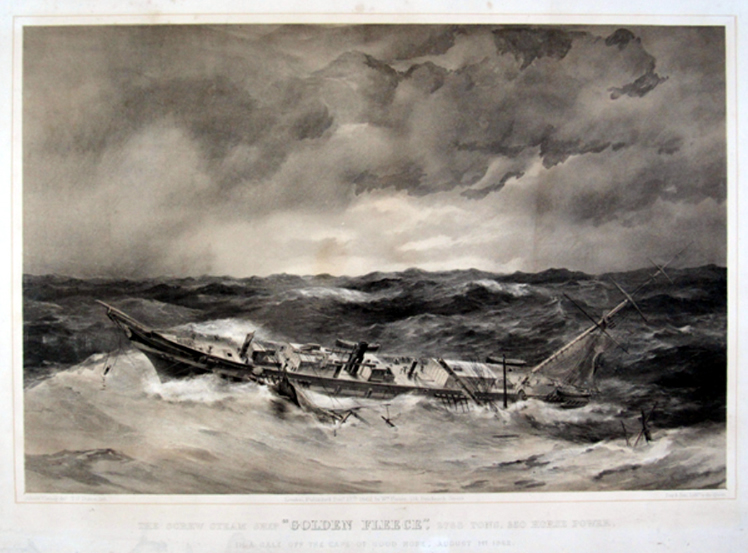
s.s. 'Golden Fleece' - A lithographic print dating from 1862 held within the collections of the Mariners' Museum and Park in the US. This print shows the vessel in distress off the Cape of Good Hope.

s.s. 'Golden Fleece' - A lithographic print dating from 1862 held within the collections of the Mariners' Museum and Park in the US. This print shows the vessel in distress off the Cape of Good Hope. [941]  [Accession Number : 1946.0545.000001]

 
s.s. 'Golden Fleece' - A lithographic print dating from 1862 held within the collections of the Mariners' Museum and Park in the US. This print shows the vessel in distress off the Cape of Good Hope.
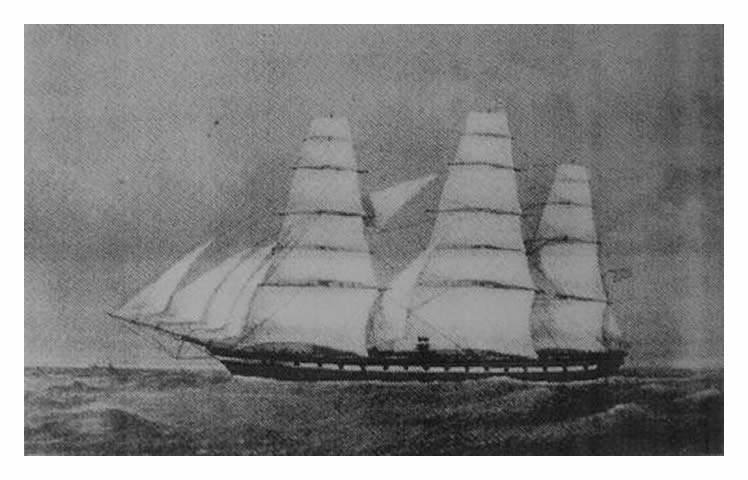
The 'Golden Fleece' was an iron hulled, auxiliary screw, three masted, vessel built at the yard of C. J. Mare & Company at Blackwall. She was 290 ft. length x 42.3 ft. breath x 33 ft. depth being of 2,091 tons. She was launched during November 1853 for London owners, Australasian Pacific Mail Steam Packet Company. On the 10th September 1869. she sailed from Penarth for Alexandria but sank in four fathoms at low water in the Penarth Roads. [1050]

 
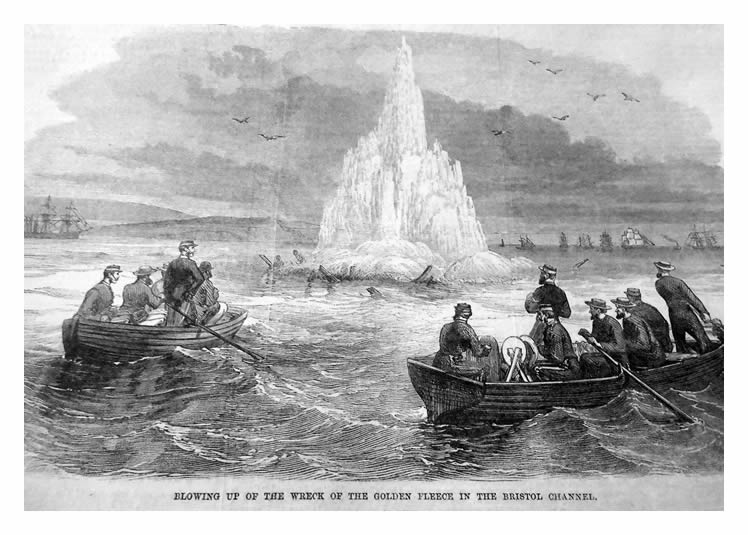
Blowing up the wreck of the Golden Fleece in the Bristol Channel.

Blowing up the wreck of the Golden Fleece in the Bristol Channel during June 1870. [000] [002] The Western Mail reported:

Torpedo Operation on the Golden Fleece in the Bristol Channel - An attack by torpedoes was made yesterday afternoon by the Royal Engineers upon the wreck of the Golden Fleece, which has been for so many months an obstruction in the channel way for shipping off Sully Island. The charges were in three iron cylinders, amounting in the aggregate to 1,500 lbs. of gunpowder, and were applied to a portion of the vessel immediately in front of the engines. A large quantity of timber was brought away by the explosion, and the general condition of the appearances displayed were such as to signify that the operation had been successful, but no actual results can be recorded until a survey by soundings has been made. There were present on the occasion Colonel Galwey, R.E., Capt. Home, R.tl., Ctpt. Malcolm, R.E., and several others of the Royal Engineer officers from Chatham; as also Capt. Locock, B.E., in charge of the fortification work upon this coast, and other scientific visitors. - Western Mail [164] [361] 15th June 1870.


1872 - On the Corrosion and Fouling of Iron Ships - The side of the bunker next the skin of the ship should always consist of a separate or distinct lining wall of water-tight boiler plate. But it not unfrequently happens that this side of the bunker consists of the naked skin of the ship, which by these causes is rapidly " pitted ” and eaten away.

This was proved to be the fact in the celebrated case of the Golden Fleece, which sunk at her anchors in Penarth Roads not long ago, and the loss was probably due to this very cause.

It is almost universally overlooked by iron shipbuilders that carbon itself is in sea-water electro-negative to iron ; so that coal dust lodging upon a surface of iron plate, exposed also to damp or to water, as in the interior of a bunker, the iron has its rate of corrosion increased by the mere presence of the coal. So also small coal allowed to lodge in the bilge of an iron ship tends powerfully to corrode the skin (if that be not cemented, and somewhat even then), and also the ribs, keelsons, &c..

The injurious action of coal on the iron of bunkers does not even end here with its chemical effect. In “ coaling ” by the usual methods and apertures in the ship’s sides and decks, the coal as shot in, strikes against and abrades, more or less, the iron plating exposed to it ; and, as in the Golden Fleece, the surface most exposed to this action may be the inner surface of the ship's skin. - Transactions of the Institution of Naval Architects Vol. XIII [1051] [499] 1872.

 
© 2014 - 2025 - penarth-dock.org.uk - all rights reserved - web design by Dai the Rat