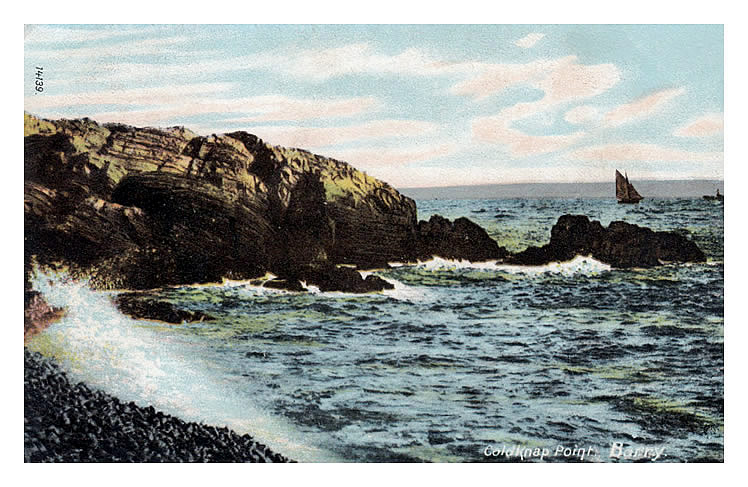
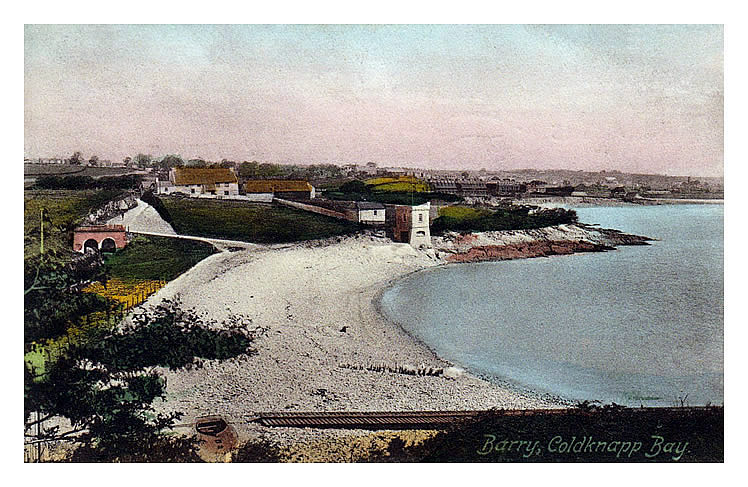
1900's - Coldknapp Point and Coldknapp Bay, Barry - Two postcard views. The upper view postdated 1905 whereas the lower is 1915, both depict an idyllic pebble bay and picturesque point. These postcards are held within the Penarth Dock Collection. [001] [20191026]
One of Coldknapp's claims-to-fame was the discovery of Roman remains on the grassy bank. There was a building with 22 rooms grouped around a courtyard which dated to the late 3rd century A.D. With regard to the derivation of the place name : 'Cold Knapp appears as Colde Knapp and The Coale in 1622 records, Coal Knap in 1762 and 1833, and Cold Knap in 1811. One possible source is the English word cold (Old English: cald, ceald). Another is coal, which in this instance could refer to charcoal. A 1762 map shows charcoal pits at Cold Knap Farm.' Many thanks to Historypoints.org. for the info. [747]
I gained a great deal of respect for this point and the sea in general one day when as a young boy I went swimming off the steep pebble beach at Coldknapp on a fairly breezy day summer day. A spring tide was incoming and a westerly breeze was blowing when I found that I was being driven away from the beach and beyond the point. I could feel the rocks beneath my feet as I passed the point but could not overcome the force of the tide. Eventually, I managed to swim closer and get a grip on the rocks beyond. When I got back to the beach in Watch House Bay, my feet were bleeding and my toe nails shredded. Don't be wimp my mates mocked!
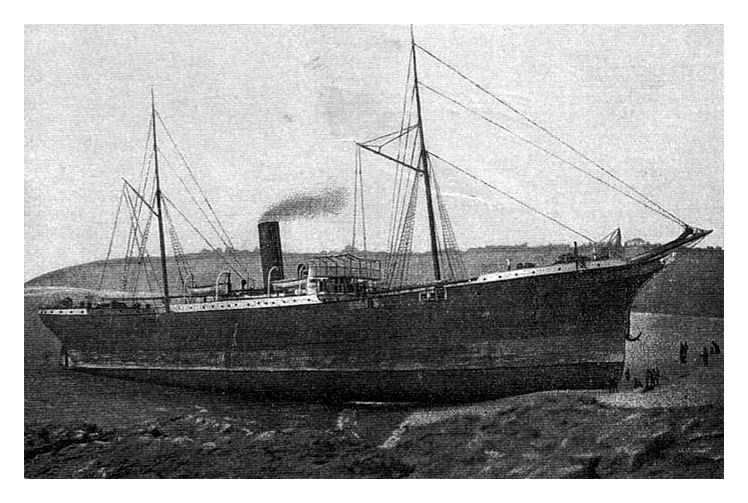
1894 - s.s. 'Eiffel Tower' at Coldknapp - The lower photograph also highlights the perils of the point when, during early October 1894, the steamship 'Eiffel Tower', owned by the Dunedin Steamship Company of Leith, ran aground during thick fog. She was, however, refloated on the next high tide and towed into Barry Docks for repairs. Many thanks to the People's Collection Wales [048] and Tom Clemett's History of Barry [746] website for the info and photograph.