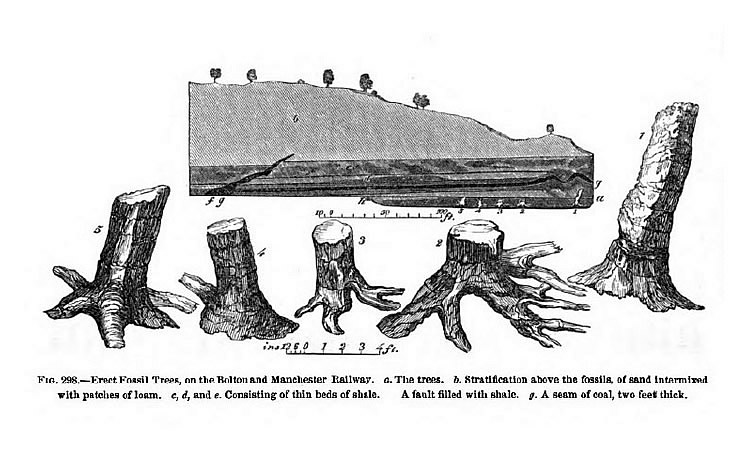
1838 - 1839 : Hawkshaw, John, Esq. : 'On Five Fossil Trees found in excavations at the Manchester and Bolton Railway' as listed within the Index to the communications read during the session 1838 - 1839 ; from the Proceedings of the Geological Society of London. [716]
The image above is taken from a book published in 1851 by George F. Richardson of the British Museum entitled 'An introduction to geology, and its associate sciences : mineralogy, fossil botany and conchology, and palæontology'. [716] The following paragraph is taken from the publication : -
'The multiplied instances of trees found erect established the fact of the coal plants having chiefly grown on the spot where they are now entombed. Not only has Mr. Hawkshaw discovered the group of trees already described, on the line of the Bolton and Manchester Railway, but Mr. Conway, on forming the railway tunnel at Claycross, five miles south of Chesterfield, found a number of fossil trees, apparently Sigillariæ, no fewer than forty in number, standing not less than three or four feet apart, and forming a perfect fossil forest. When we reflect on the accidental nature of these discoveries, it is impossible to resist the conviction that the earth may contain innumerable forests entombed on the spots where they grew, many of which the progress of discovery will bring to light.'
The foregoing provides a vivid insight into the level of understanding of the science of geology at the time when Charles Darwin was bringing to the table a revolutionary theory of how mankind and the other life forms inhabiting our planet had evolved. John Hawkshaw was not only an extraordinary engineer but his interest in geology contributed greatly to human understanding of how coal deposits are formed. It all occurred during a period aligned with the evolution of the coal trade at Cardiff and Penarth.