Five Men Injured - Explosion in Ship's Hold at Penarth - Vessel Damaged & Victims Severely Burnt - 'Shortly after ten o'clock this morning an explosion took place in the hold of the Norwegian barque Eliza, at present lying at the top of the Penarth Dock. The Eliza left Cardiff with her cargo some days ago, but had to put back to Penarth on account of the bad weather. The cause of the explosion is not at present known, but it was of a rather severe character, for, besides doing damage to the ship, five men were severely burnt. Dr. Barry was soon on in. attendance, and did what he could to relieve the sufferings of the injured men who were placed on a railway truck and taken at once to the Cardiff Infirmary.' - Evening Express [135] [361] 15th September 1903.
The Gas Explosion at Penarth - 'Upon inquiry at the Cardiff Infirmary today it was stated that the three patients in that institution who, with another man, were burned about the face and hands in the explosion of coal gas on the Norwegian barque Eliza. at Penarth Dock yesterday, were in a very satisfactory condition.' - Evening Express [135] [361] 16th September 1903.
Penarth Ship Explosion - 'On inquiry at the Cardiff Infirmary this afternoon, we learn that all the men admitted to the institution suffering from the result of the explosion on board the Norwegian barque Eliza, at Penarth Dock, on Monday, show signs of a, speedy recovery.' - Evening Express [135] [361] 17th September 1903.

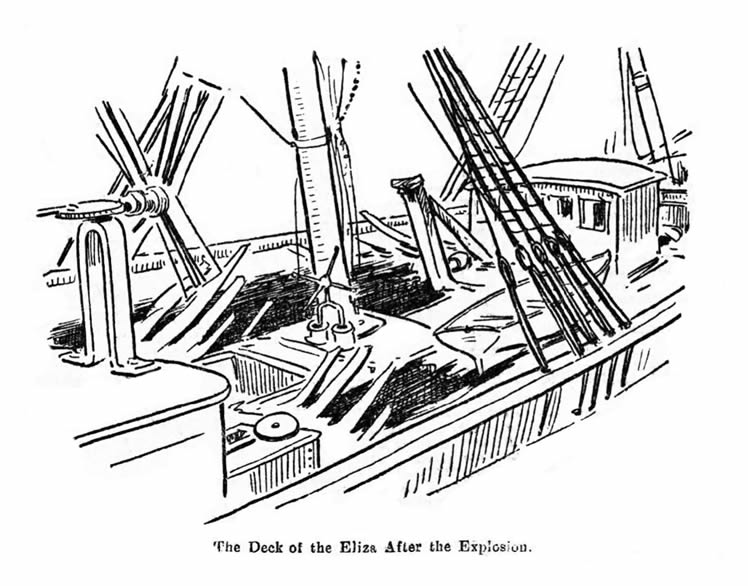
Deck Blown Up - Barque Damaged in Penarth Dock - Explosion of Coal Gas - Five Men Injured.
An explosion occurred on board the barque Eliza, of Fredrickstadt, in Penarth Dock on Tuesday morning, shortly after ten o'clock, by which four of the crew and the captain were injured. The four men were taken to Cardiff Infirmary in a special T.V.R. train, while the master, Captain Berg, who remained on board, was seen by Dr. Barry.
The Eliza left Swansea last week with 350 tons of anthracite coal for the Baltic. She encountered the full force of the gale on Thursday, and early on Friday morning lost her anchor chains and sprang a leak, making three inches of water per hour. She was towed into Penarth Dock by the tugs Frank Hanley and Fastnet.
An eye witness of the explosion, who was at the time standing on a ship close to the Eliza, says that he saw no flames, but suddenly there was a tremendous report, and a large portion of the deck was blown into the air. At the time four men and the captain were standing on the deck. The lifeboat, weighing several hundredweight, was lifted nearly 20 feet and fell upon two of the men. The captain was blown back against the starboard bulwarks, and his back was injured. The planking of the deck and the bulwarks were blown into the dock. One of the men had a most remarkable experience, being, it is stated, blown into the rigging. By a stroke of good luck he managed to hold on, and was able to climb down the rigging and regain the deck. One of the crew, who was in the afterpart of the ship just before the time of the accident, was about to go into the hold and had opened the hatch-covering when he saw a flash of flame.
Names of Injured. The following are the names of the injured men who were conveyed to the Infirmary : -
H. Hansen (46). Norwegian, A.B.
George Fulton (40), married man, living at Swansea, A.B.
R. Kristifer (25). of Riga, Russia, A.B.
Peder Klappin (46), Norwegian, carpenter.
Of the above named Hansen has been on the vessel four months, but the others were shipped at Swansea only last week.
The special train conveying the injured men arrived at Cardiff shortly after half-past 11. It consisted of an engine and a coach, and contained the four injured men and a seaman from an adjoining ship, who accompanied them. Three of the men were very seriously injured, and were placed on stretchers and conveyed by Taff Vale porters to the Infirmary. The other man was able to walk, but he had been badly burned. Two of them were unconscious, and the third was only semi-conscious. It was a melancholy procession from the station to the Infirmary, and was followed by a large crowd. One of the men appeared to be in great pain, for he turned over repeatedly on the stretcher. The men's hair bad been singed close to the skin, and their eyelashes and moustaches were burnt off.
On Tuesday night the injured men were reported to be progressing favourably. Their apparent injuries are not so serious as they were at first thought to be, but in cases of this nature it is impossible to state what the effect of the terrible shock will be. At present, however, the medical attendants at the Infirmary do not apprehend any fatal results.
How the Gas Ignited. No one seems able to say exactly how the explosion occurred, but it is believed that when the hatch was partly uncovered gas rushed out and became ignited by the fire in the galley. A portion of the ship then caught fire, and an explosion followed.
Injured Man Interviewed. The man who was able to walk is a Norwegian, and speaks English indifferently. With his hair, eyelashes, and moustache burnt off, and large blisters all over his face and hands, be presented a curious appearance. One of our representatives managed to learn from him that the vessel on which the explosion had occurred was a Norwegian barque named Eliza, and had loaded coal at Swansea last week for Sweden. She was driven up the Channel by the storm of last Thursday, and lost her anchors. She was towed into Penarth Dock, and was waiting there until new anchors were made. At the time the explosion occurred there were nine persons aboard, including the captain. They knew a quantity of gas must have accumulated in the ship, and one of them partly removed the covering of the hatch so as to allow some of it to escape. No sooner had he done so than there was a terrific explosion, the deck of the vessel being blown high into the air. Some of the men were also blown on some distance, and as they fell they were buried by falling debris and injured. The cook was blown into the hold, but escaped with slight injuries. The lifeboat was thrown from its blocks, and fell on the back of one man. Not one of the nine men escaped without some injury, but the injuries seemed to be serious in only three cases. The captain was hurt, but refused to go to the Infirmary, and was accommodated on an adjoining vessel. Assistance was quickly rendered by seamen from adjoining vessels, and no time was lost in obtaining medical attention for the injured. "Are you in pain?" the scorched Norwegian was asked, but he shook his head as he went into the Infirmary to receive attention.
The Cook's Story. It was quite pathetic to see the cook, a young negro, still at his post two hours after the explosion occurred. The captain retired to his quarters and could not be seen, and the rest of the crew were scattered - some being at the Infirmary and others on neighbouring vessels. But the young negro could not tear himself away from the ship. Our representative found him standing at the door of the small "kitchen," containing his stove and cooking utensils, now completely wrecked. What was once his cookhouse is now little better than a scrap heap. The cook told the following brief story : - "I was sitting in the cookhouse, peeling potatoes. The captain stood over there (pointing to amidships), and a man was standing near him smoking. All at once the plates and things began to fall about, and I fell over. I remember nothing else, but when I came to I found my foot was badly scalded."
One eye-witness of the accident states that it is not true a man was blown into the rigging but upon this point there is contradictory evidence.
The force of the explosion was felt more in the fore part of the vessel than aft.
The Barque's Dimensions. According to Lloyd's Register the Eliza, constructed of wood, was built in 1852 at Drontheim her port of registry being Fredrickstadt. Her net registered tonnage is 363 tons. She is Norwegian owned, and the master's name is Captain H. J. Berg. - The Cardiff Times [019] [361] 19th September 1903.
