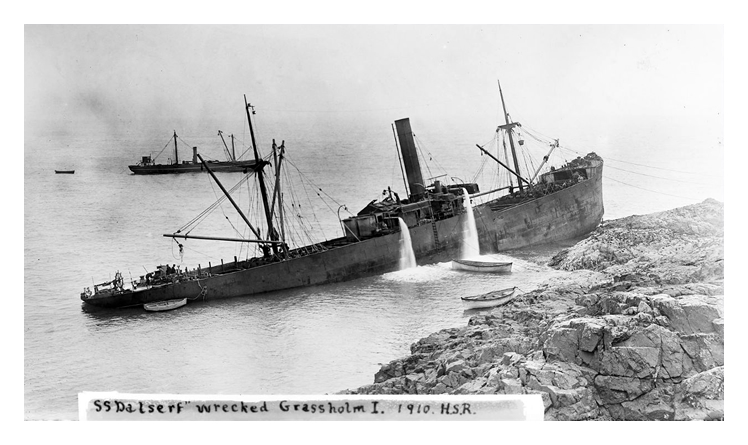
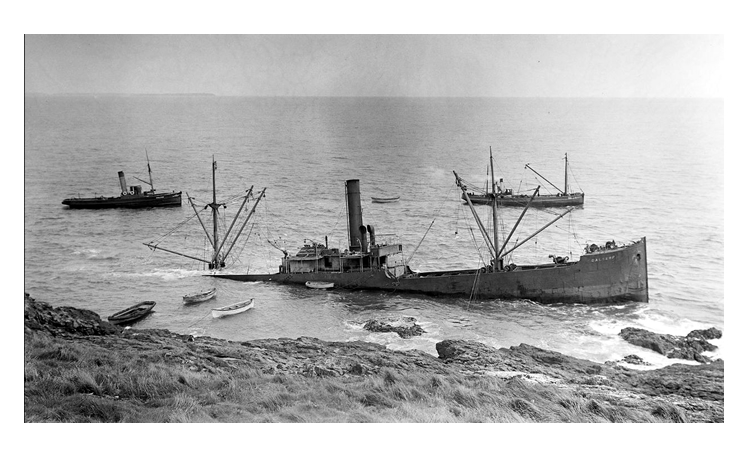
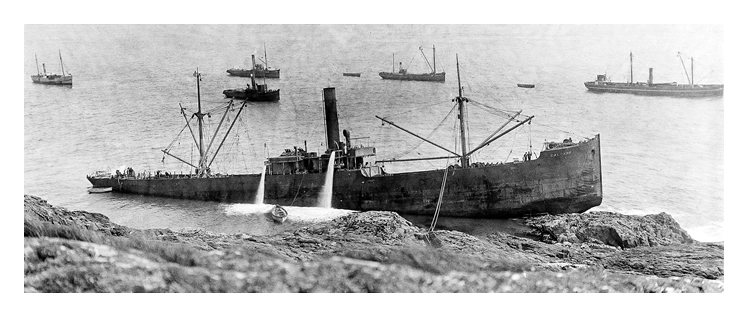
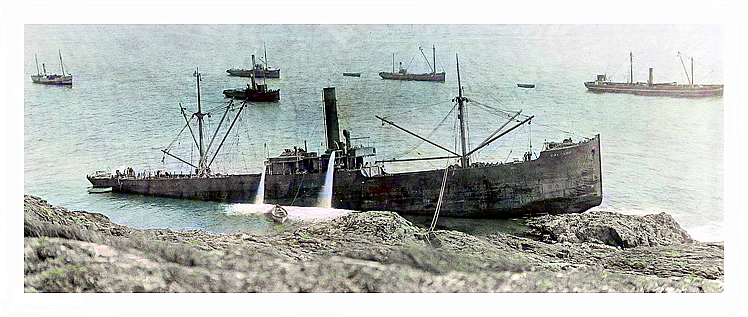
'The Dalserf was a steel-hulled steamship built at Stockton on Tees by Richardson, Duck & Co in 1909. Technical and configuration specifications are given as 1849gt, 1017nt; 260ft length x 40ft breadth x18ft depth, propelled by a set of vertical direct acting triple expansion surface condensing engines with three cylinders, the diameters of which were 20 inches, 33 inches, and 54 inches respectively, and had two steel boilers, the loaded pressure being 180 lbs, all of which engines and boilers were made by Messrs. Blair & Company, of Stockton-on-Tees. She had four bulkheads and was constructed with a double bottom divided into nine water ballast tanks with a total capacity of 961 tons. She was owned by Mr. James Campbell, of Post Office Chambers, Middlesbrough, at time of loss and registered at Glasgow. The Board of Trade undertook an inquiry into the loss at Middlesbrough over the days of 15th, 16th and 19th September 1910.
It reported that the Dalserf had left Penarth on the 9th July, about 7.50 p.m., under the command of Mr. Evan Williams. Her crew consisted of 19 hands all told, and she carried a cargo of 2,652 tons of coal, consigned to the Admiralty at Oban. The weather was very foggy and at around 8am on the 10th July, rocks were reported by the look-out (and simultaneously seen from the bridge by the master and second mate) right ahead; the master rang the engine-room telegraph full speed ahead at the same time ordering the helm 'hard-a-starboard', but on seeing that the vessel would not clear the rocks, without taking his hand off the telegraph rang full speed astern. The ship's head swung about two points and she struck the rocks about a minute or two after they were first seen, striking the rock on the port side of her stem first and wedging herself between that rock and another on the starboard bow. The engines were kept going astern for some time but the ship remained fast; they were then stopped for a little, then put full astern again, then stopped.
Tanks and wells were immediately sounded, when the fore peak was found to be filling and No. 1 tank making water at the rate of one foot an hour; all other tanks and wells were dry, and the sea was quite smooth when the vessel struck, and no tide rips were seen or heard. About 9 a.m. the ship's stern swung round to the northward. At 10 a.m. the crew commenced to jettison cargo out of No. 1 hold to lighten the ship forward ; this was continued until about 3 p.m. and then stopped after throwing overboard about 25 tons. The ship then commenced working and striking heavily on the rocks, the tanks were again sounded and No. 4 and 5 tanks were found to be filling and water running into the engine-room. About 3.30 p.m. the s.s.Masterful was signalled and she offered to report the casualty, and at 4.30 p.m. HMS Royal Arthur came up and sent assistance to put cables on shore aft.
On Monday, 11th July, as the ship practically filled with water. when the tide made and worked and struck very heavily on the rocks, the master transferred all the crew to Torpedo Boat 049 which proceeded with them to Milford, as he did not consider it prudent to keep them on board any longer. The master and chief engineer remained on board.
Salvage operations were commenced on the 11th July. Some 1300 tons of cargo had been discharged to lighten the hull, and additional pumps were put on board. Operations continued despite a severe easterly gale on 2 August when the ship took on a steer list, and then on the 21st, with the commencement of another gale, the master and chief engineer finally left her. At that time the after part of the vessel from the engine-room skylight was completely submerged, and further operations of salving were abandoned.
The Dalserf eventually broke up into five pieces and was declared a constructive loss. The master was found to be repsonsible for the loss due to an error in judgement in proceeding inside the Smalls when the better route in the weather conditions would have been outside.' [Coflein, Maritime Officer, RCAHMW] [093] |