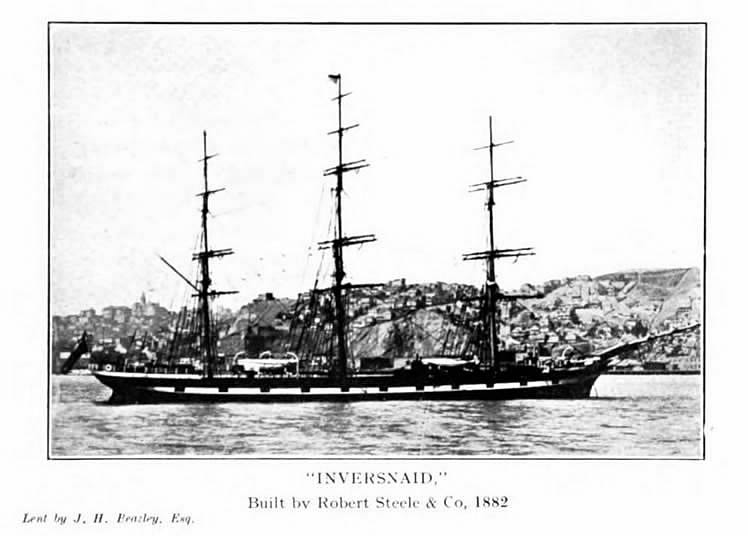
The Loss of the Inversnaid - Board of Trade Inquiry at Cardiff - On Monday morning, Mr Rothery, the Wreck Commissioner, assisted by Admiral Rickard and Captain Cosens, nautical assessors, hold an inquiry into the loss of the iron sailing-ship Inversnaid, of Liverpool. Mr Howard Smith and Mr Waldron appeared on behalf of the Board of Trade, and Mr Downing for the managing owner (Mr Malcolm Anderson).
The lnversnaid was built at Greenock in 1882. Her gross tonnage was 1,613, and her register 1,549. She was owned by Messrs Thompson, Anderson and Co., Fenwick Chambers, Fenwick-street, Liverpool. They bought her in September last for £11,300, and this was her first voyage under their management. They spent also £2,000 in fitting her up, and insured her for £13,000, of which sum £31,000 was underwritten by Messrs Anderson themselves. Her cargo was valued at £1,740, and was insured for the sum of £ 1,000.
She took on board 2,155 tons of Ferndale steam coal in Penarth Dock, and sailed on October 14th, bound for Singapore, with a crew of 30 hands. On the 16th the vessel was seen off Lundy, during the severe gale that blew about that time, and it was noticed that she had a heavy list to starboard, that her sails were in shreds, and that she was shipping heavy seas.
She was last seen by the master of the Glasgow steam-tug Flying Fox, who was cruising about Lundy at the time and hailed her. The captain wanted to make a bargain to tow him to Cardiff, but the tug-master said it was not the time or place to make a bargain, but he would do what he could for him, and advised him to get to the leeward of Lundy, when they might be able to get a hawser on board. The Inversnaid attempted to do this, but failed. Afterwards a heavy squall came on, and when it had cleared away nothing could be seen of the ship.
The managing owner stated in the course of his evidence that though he had not the slightest doubt that the vessel had gone down, there were people in Liverpool who were insuring her as recently as last week at 90 per cent. — The court found that the vessel was an exceedingly fine one, and left Cardiff in a very good condition so far as hull and rigging were concerned. At the same time she had not been trimmed and loaded so efficiently and effectually as she might have been. There was no cause to blame the master of the Flying Fox, or to doubt that he exercised every possible effort to render assistance. There could be, finally, no doubt whatever that the cargo having shifted, she had gone down in the squall owing to her having turned over. There was not the slightest reason for supposing that she was still afloat, or that she had not gone down. - South Wales Echo [163] [361] 15th February 1887. |