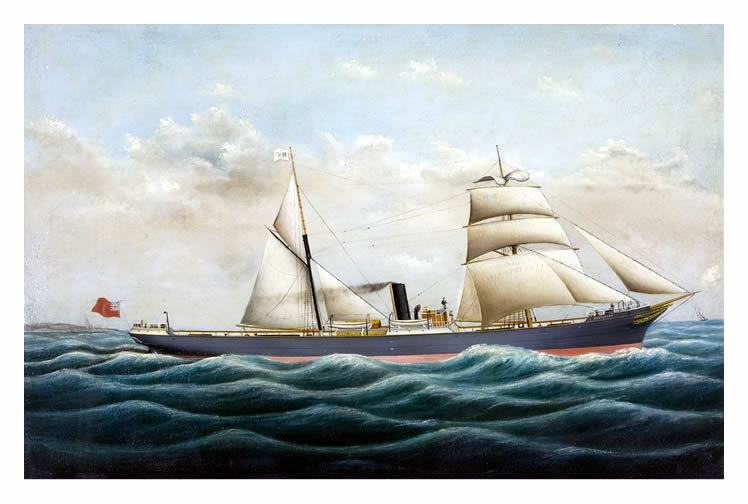
The Loss of the Castleton of Cardiff - Board of Trade Inquiry - In the Crown Court at the Town-ball, Cardiff, on Tuesday, Mr Rothery (Wreck Commissioner), assisted by Admiral Pickard and Captain Cosens (nautical assessors), held an inquiry into the loss of the s.s. Castleton, of Cardiff, of which Mr Matthew Cope, of that port, was the managing owner. Mr Howard Smith, barrister, appeared for the Board of Trade, Mr T. H. Stephens was for the owners, and Mr Carpmael, London, represented the Royal Mail Steam Packet Company, to whom the cargo belonged.
The Castleton was an iron screw steamer belonging to the port of Cardiff, of 1,751 tons gross register, and 1,149 tons net. The vessel, which was built at Wallsend in 1879, left Penarth Dock on the 14th October last with a crew of 23 hands all told, and a cargo of 1,924 tons of coal, besides 510 tons in her bunkers. She was in charge of a fully-licensed pilot, who left her about two o'clock in the afternoon, and she then proceeded down channel, since which she had not been heard of. However, 50 feet of her rail, and portions of three of her boats, had been picked up in Bideford Bay, and as no tidings had been received of her at her destination, it was supposed that she bad gone down with all hands.
The court found that the vessel was thoroughly equipped and in a good and seaworthy condition when she left Cardiff that her hatches and ventilators were properly secured and that necessary precautions had been taken to prevent the cargo from shifting by means of shifting boards which ran through the vessel. In reply to a question as to whether the vessel was overladen, the court found that she had on board altogether 2,434 tons, in addition to which she had two spare crank shafts, a spare propeller, and a spare tail shaft, and other stores to the value of £2,000, which would add considerably to the weight of the vessel.
According to the evidence of the builder of the vessel and the other witnesses called, there could be no doubt that the freeboard of the vessel when she left Cardiff was only 4 feet 2 inches, whereas, according to the evidence of Mr Sloggett, Lloyd's surveyor, it should, by the rules of the Board of Trade and Lloyd's, have been 4 feet 6 inches for a winter voyage. It was clear, therefore, that the Castleton had an insufficient freeboard.
In the opinion of the court the vessel was greatly over laden when she left Penarth Dock. The cost of the Castleton was £26,700, and at the time she went down she was insured for £26,000, notwithstanding that she had been seven years in use. The court were of opinion that her value was grossly exaggerated in the insurance, doubting very much whether, at the time of her loss, the vessel could have been worth much more than £17,000 or £18,000.
Her freight and equipments had not been insured, but as they were totally valued at something like £2,000, that made no material difference to the other insurance. The vessel was lost, no doubt, through encountering the very severe gales which prevailed upon these coasts during the 15th and 16th October, and being, as the court believed her to have been at the time, too deeply laden, she had less power to resist the force of the gale than otherwise would have been the case. Whether or not, if she had been more lightly laden, she would have been able to have ridden out the gale it was impossible for the court to say, seeing that the gale was a very hard one, and that many vessels not too deeply laden undoubtedly succumbed.
Mr Howard Smith asked the court to order Mr Cope, the managing owner, to pay a portion of the costs of the inquiry. — The Commissioner declined to do so, saying that Mr Cope, by his conduct had not increased the expense of the inquiry at all. If the vessel bad not been too deeply laden there would still have been an inquiry owing to the loss of life. Moreover, he would not condemn owners in costs where their conduct had not contributed to the expense of the inquiry, because he would not be a party to relieving them of any other liability to which they might be exposed from the consequences of the ship being too deeply laden. - South Wales Daily News [325] [361] 16th February 1887. |