|
|
Penarth Dock, South Wales - the heritage & legacy . . . |
|
|
Penarth Dock, South Wales - the heritage & legacy . . . |
 |
|||||
 |
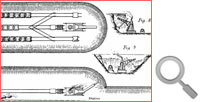
Volume Eleven - Pre-Victorian to the Present Day - some more aspects - The Steam Navvy and the Dock Extension of 1883 . . . On the top of the bucket are fixed two plates strongly gussetted, between which the lower end of the arm is secured by a through pin. There are also four shackles furnished with screw swivels, which distribute the strain, and permit the adjustment of the angle that the cutting edge of the bucket makes with the arm. The two top plates also carry the L shaped hinges rivetted to the flap or door. The handle or " bale " of the bucket swings on pins fixed about centrally on each side ; it is well arched to allow room for the dirt, and is secured to the snatch block by a pin and strap. The door is fastened by a stout bolt, fixed on the outside opposite to the hinges, and kept closed by a spiral spring protected by a casing. On the bolt is a short arm passing through a slot in the casing, and connected by a link to the catch lever for opening the door ; at the outer end of this lever is a pulley, round which a cord is rove, the free end passing through a sheave on the bucket arm and thence to the wheelman. By pulling the cord the bolt is withdrawn out of its socket, and the door falls open by its own weight, and hangs vertically ; when the bucket falls back from position C to D, Fig. 1, it overtakes the door, and the bolt and socket being both made with sloping edges, the door latches itself automatically in closing. Plan of Excavation. — When making a cutting, the navvy first drives a “ gullet, ” unless the excavation be commenced along the side of a bank or hill, as shown in Figs. 7 and 8. The output depends mainly upon the completeness of the means for removing the excavated stuff.
The most effective way is to provide double roads, one on either side, branching out by proper curves from a central road, and also connected with the latter by short “ jump " lines at abrupt angles immediately behind the navvy, as shown in Fig. 6. |
||||
| Introduction | |||||
| Contents | |||||
| Search this site | |||||
| Contributions | |||||
| Links | |||||
| Recent Updates | |||||
|
|||||
| | volume 11 | chapter 16 | page 120 | << previous page << | index to volume eleven | >> next page >> | | |||||
|
|||||