|
|
Penarth Dock, South Wales - the heritage & legacy . . . |
|
|
Penarth Dock, South Wales - the heritage & legacy . . . |
 |
||||
 |
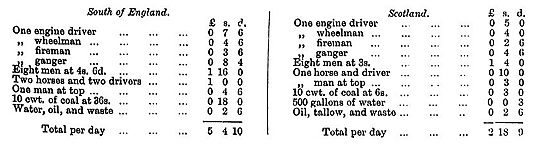
Volume Eleven - Pre-Victorian to the Present Day - some more aspects - The Steam Navvy and the Dock Extension of 1883 . . . Output. — The output is affected by the hardness of the stuff. For the very hardest clay intermixed with stones and boulders, the capacity of the bucket is 1 cubic yard ; for all other hard stuff 1¼ yard, which is the most useful size ; whilst for loose earth, sand, gravel, or drift, 1½ or even 1¾ yards can be used. For all sizes of bucket the number of cuts per hour remains approximately the same, about three-quarters of a minute being the time necessary for each. Moving forwards, laying rails, and waiting for wagons may be set down as a deduction of ten minutes per hour, leaving fifty minutes for cutting, which gives say sixty as the number of bucket loads per hour, or 600 per day of ten hours, as the theoretical capacity, equivalent to a daily output of 600, 750, and 900 cubic yards with the 1-yard, 1¼-yard and 1½-yard buckets respectively ; and this agrees well with the results actually obtained. Working Expenses. — The working expenses vary according to the locality. The following examples, taken from two different contracts, in the south of England and in Scotland respectively, may be considered as representing the two extremes, the output being in each case about equal : -
In the first example the prices are all high, particularly that of the coal. In the second the prices are moderately low. The average may therefore be set down at from £3. 10s. to £4. per day. |
|||
| Introduction | ||||
| Contents | ||||
| Search this site | ||||
| Contributions | ||||
| Links | ||||
| Recent Updates | ||||
|
||||
| | volume 11 | chapter 16 | page 180 | << previous page << | index to volume eleven | >> next page >> | | ||||
|
||||