|
|
Penarth Dock, South Wales - the heritage & legacy . . . |
|
|
Penarth Dock, South Wales - the heritage & legacy . . . |
 |
|||||
 |
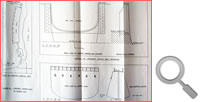
Volume Twelve - Pre-Victorian to the Present Day - further aspects - Report upon Penarth Dock - 1984 . . . 3.2 - Dock Walls The main purpose of any dock is to enclose the site and act as a retaining wall for the material surrounding the site. Dock walls have to withstand a horizontal pressure at the back of the wall which tends to either overturn the wall by causing it to pivot on it's outer edge (which sinks into the soil in the process) or to make the wall slide forward on it's base. This pressure varies according to the type of material surrounding the site and on the height to which the wall is built. At Penarth Dock the material surrounding the site was of an alluvial nature [Alluvial soils are deposited by the action of river water] and the presence of the River Ely caused water to build up behind the walls, a problem which was further complicated by the fact that the walls of Penarth Dock were relatively large. Two distinct types of wall were used at Penarth Dock. The first was a fairly standard solid wall and the second was the more unusual arched wall. 3.2.1 - Solid Walls When the dock was originally constructed the only solid was a 370 feet length at the west end of the main dock. This was used as a quayside since at that time there was sufficient width at the end of the dock to allow a vessel to berth. A particularly interesting feature of this wall was the fact that it contained a graving dock entrance which was never actually used. The entrance was designed to use a floating caisson (or ship caisson) type gate which would have been similar in appearance to that used in the graving dock situated in the north west corner of the Roath Basin at Cardiff Docks (see figure 8).
|
||||
| Introduction | |||||
| Contents | |||||
| Search this site | |||||
| Contributions | |||||
| Links | |||||
| Recent Updates | |||||
|
|||||
| | volume 12 | chapter 13 | page 170 | << previous page << | index to volume twelve | >> next page >> | | |||||
|
|||||