Mr. William Robert Chaplin [1863-1943] was Warden of Trinity House and in addition a prolific author whom described Flat Holm Island in a book entitled 'The Somerset Coast' published in 1909: [1326] [499]
The name, 'Holm' is Norse for 'island,' and remains evidence of the Danish descent upon these coasts in A.D. 882.
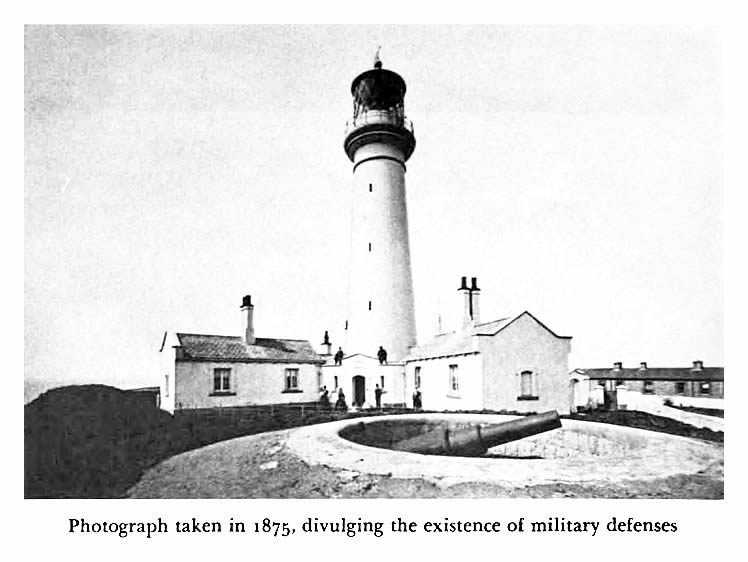
Flat Holm is geographically and politically in South Wales, is the property of the Marquess of Bute, and is situated in the parish of St. Mary, Cardiff. Once a year the vicar and curate of St. Mary's visit the island and hold service in the barracks. Four batteries are situated on the island : the Castle Rock, Farm, Lighthouse and Well batteries. The tall white lighthouse that shows up so prominently from the shore at Weston is situated on Flat Holm, and rises to a height of a hundred and fifty-six feet.
A singular phenomenon obscured the light in February 1902, when a shower of sticky whitish-grey mud fell and completely covered the lantern. Scientific men explained this happening as due to a portion of a dust-shower driving from the Sahara, and being converted into mud by the Channel mists. A day's hard work was necessary before the glass was properly cleaned.
A light was first shown here in 1737, when it consisted of a brazier of burning coals ; no very effectual beacon on foggy nights. Nor was it greatly improved by the early years of the nineteenth century, for it was then still possible for such disasters as that of the William and Mary to happen. This unfortunate ship was wrecked in 1817, between Flat Holm and Lavernock Point, which marks the extremity of Brean Down ; and sixty lives were then lost.
The present light, of the occulting variety, has a power of 50,000 candles, and is visible for eighteen miles.
The total population of Flat Holm is twenty. Here is an inn. There are two fresh-water springs on the island.
|