Penarth Dock, South Wales - 150 years - the heritage and legacy  
Penarth Dock, South Wales - the heritage & legacy . . .

Volume Thirteen - Pre-Victorian to the Present Day - even more aspects - Slavery - echoes of the past . . . .

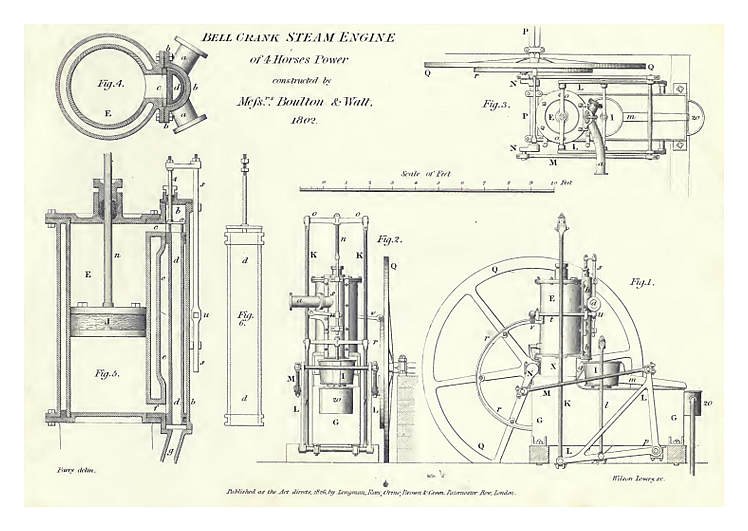
A 4 h.p. Bell Crank Steam Engine constructed by Boulton & Watt in 1802.

A 4 h.p. Bell Crank Steam Engine constructed by Boulton & Watt in 1802 which would have been similar to that built, exported and erected at the Ashley Hall Estate c.1813. The drawing above is from the Boulton & Watt Collection [Reference: GB 143 MS 3147/5/796] - 'For John Ashley, Manningfield Estate, Jamaica, Sugar plantation engine ordered by Vaughan & Longmore of Bristol. According to the Catalogue of Old Engines, the engine was actually erected on the Ashley Hall Estate. The original drawings for this engine were made in September 1813.' [1368]

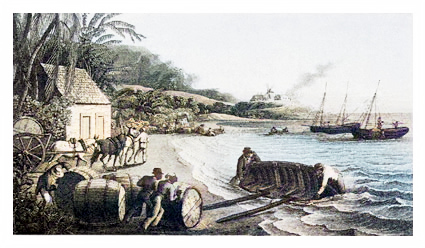
Delivery of barlles of sugar juice to the beaches!

At the start of the 19th century steam engines began replacing slave and/or mule-driven rotating mills which then provided greater and continuous power to roll and crush sugar-cane with the resultant extracted juices. The crushed cane waste, named bagasse, could be dried and used as fuel for the boiler. Once the cane was cut, it required processing promptly otherwise the juices ferment and, therefore, become unfit for export.

The bell crank steam engine above was probably put to work on the Ashley Hall Plantation to assist processing efficiency by driving sets of rollers via a geared arrangement to feed and compress the sugar-cane. The extracted juices would then be further processed and filtered and filled into wooden barrels for delivery to ships in the harbour.

The use of sugar increased to an estimated 90-lbs (40.9 Kg) per person per annum by the end of Queen Victoria's reign in 1901.

 
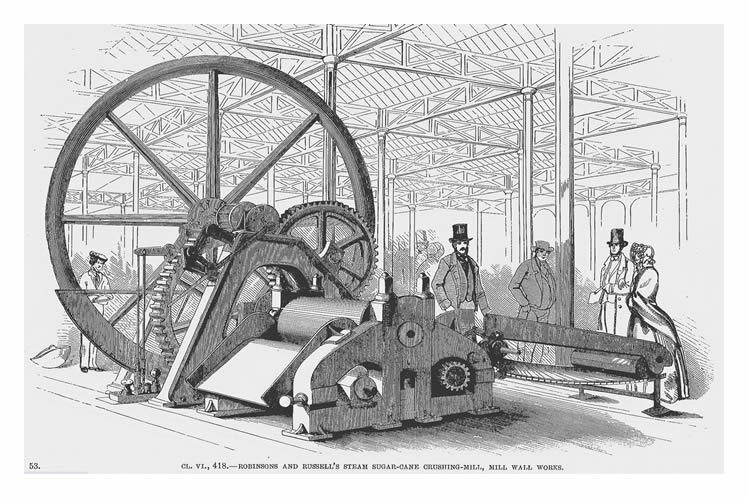
A Robinsons and Russell's Steam Sugar-Cane Crushing Mill, on show at the Mill Wall Works, London.
A Robinsons and Russell's Steam Sugar-Cane Crushing Mill, on show at the Mill Wall Works, London as advertised at the 1851 Great Exhibition. This type of mill was commonplace at the plantations although Henry Bessemer had developed a vertical 'plunger mill' also in the mid 19th century. I am, however, not sure what earlier type of crushing machine was installed at the Ashley Hall Estate to couple with the bell crank engine above. [016]
 
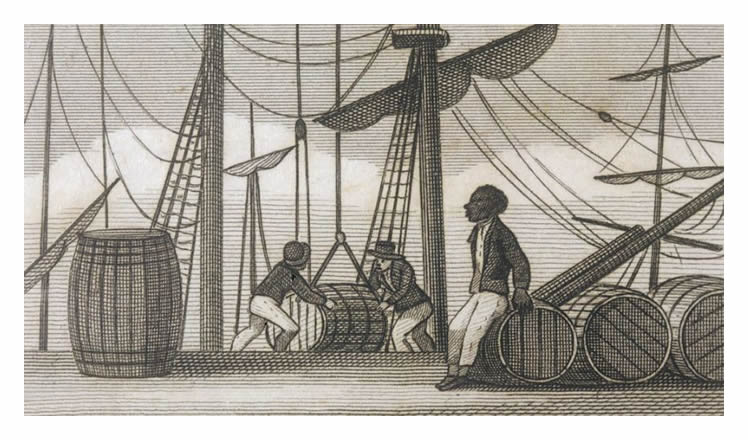
Sugar in barrels being unloaded at the Port of Bristol awaiting refining for the domestic market.

In the text above the firm of Vaughan & Longmore of Bristol are mentioned and this significant since in the late 18th century, the Port of Bristol was the centre of Caribbean sugar importation and was only outdone by the Port of Liverpool at the turn of the 19th century. Sugar was the most profitable of all of Bristol's industries, hence, it boasted 22 sugar refineries. In the 18th century half the sugar arriving in Bristol came from Jamaica and as this trade grew it brought vast riches to the City of Bristol and the sugar refiners entered into the higher echelons of local society.

These processors refined the crude Muscovado and white sugars shipped across the Atlantic from the plantations such as at Vere, Jamaica, and which used for domestic purposes the whitest 'Clayed' or 'Lisbon' sugar would command the highest prices. There was a 'sweet tooth' boom across the monied classes of British society and a great market for this refined sugar to sweeten food and drinks especially tea. Bristol was home to groups of prosperous sugar merchants, as well as the planters, otherwise known as 'Absentee Owners' who returned to retire in their upper-class, grand estates and mansions here in the 'Land of the Free.'

© 2014 - 2026 - penarth-dock.org.uk - all rights reserved - web design by Dai the Rat