|
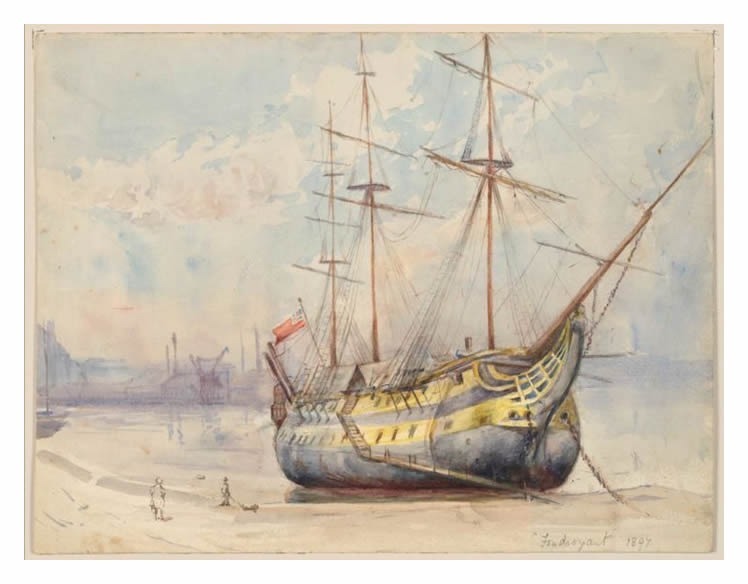
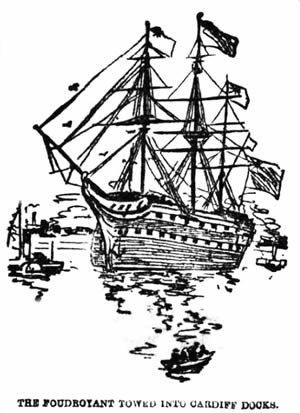
1897 - H.M.S. Foundroyant - Nelson's flagship at Cardiff. She was an 80-gun, third-rate ship of the line, launched in 1798. She was Admiral Nelson's flagship from June 1799 until the end of June 1800. She was used as a school-ship being a training vessel for boys and restored her to her original appearance at a cost of £25,000. To offset the restoration cost, it was then decided to exhibit her at various seaside resorts including Cardiff.
The above artwork is held at Amgueddfa Cymru – National Museum of Wales [Item Number: NMW A 16321] [629]
The title of the work, however, appears to misspell the vessel's name as 'Fondroyant, 1897' ; as does the article published in the Cardiff Times below.
|
| |
 |
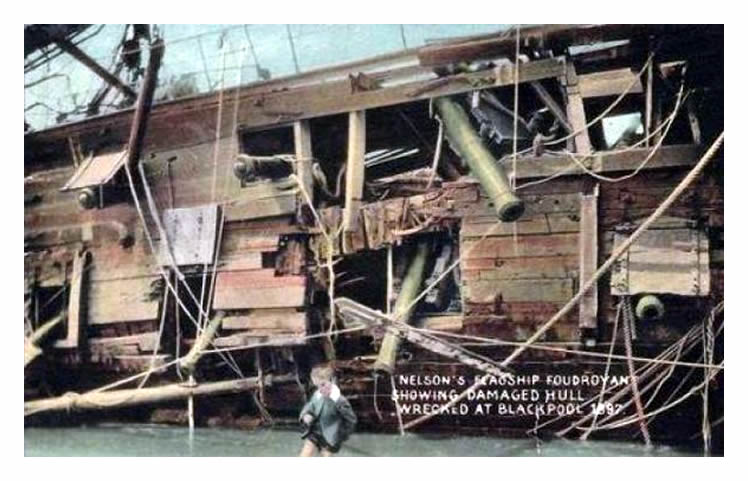 |
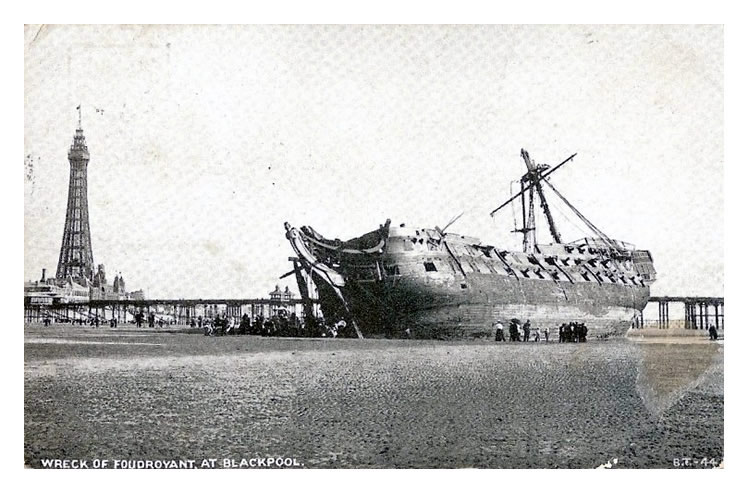
According to Wikipedia [043], later the same year she was at Cardiff, 'Foundroyant' was towed to Blackpool and could be visited for a small entrance fee. On 16th June 1897 during a violent storm, she parted a cable and dragging the remaining anchor, went ashore on Blackpool Sands, damaging Blackpool North Pier in the process. The Blackpool lifeboat was able to rescue all 27 of her crew.
|
| |
The North Wales Times reported on the 20th August 1898 that:
FATAL ACCIDENT. A fatal accident occurred at Blackpool on Wednesday. The Fondroyant, Nelson's flagship, was wrecked at Blackpool 14 months ago, and a company was formed to manufacture various articles from the copper and oak of the hulk. All that remained of the wreck was the keel. It weighed several tons, and was embedded in the sands. In order to raise the keel dynamite was used, and the repeated explosions on Wednesday attracted large crowds of visitors to the sands near the North Pier. After one of the explosions it was discovered that a piece of oak weighing a hundredweight, and containing a large copper bolt, had been thrown 50ft. into the air. The mass struck a woman named Gates, of 105, Stockton-street, Moss-side, Manchester, killing her instantly. Her little son was with her when the accident occurred. Both had gone to Blackpool for the day. - North Wales Times [1375] [361] 20th August 1898.
|
| |
 |
The Foudroyant. NELSON'S OLD FLAGSHIP AT CARDIFF.
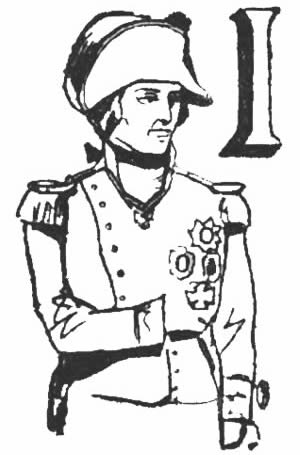
"I LOVE her as a proud father loves darling child, and glory in her deeds." It was in such terms as these that Lord Nelson wrote well nigh a century ago of the grand old battleship that now lies peacefully in the East Dock at Cardiff.
It's a long time (says one of our correspondents) since I spent a more interesting afternoon than I did on Monday strolling round the decks of the Fondroyant. At one plunge I seemed to have left Cardiff and the fast dying nineteenth century far away and to have returned again to that age when Napoleon's name was a terror in Europe, when at a date prior to Waterloo the battle of the Nile was fought and won, and Nelson at Trafalgar found, as England had expected, that every man had done his duty. There isn't a finer old battleship afloat than the Foudroyant, and, with the exception of the Victory, not an older vessel floats on British waters.
In May, 1798, Lord St. Vincent wrote to Lord Nelson :—" The Foudroyant is launched at Plymouth, and all agree she is the most perfect ship that ever swam on salt water." I may here observe in passing that a few months before her launch she had been selected by Nelson to carry his flag, and but for the impossibility of completing her in time she would have been the flagship at the battle of the Nile.
In 1799 Lord Nelson transferred his flag to her from the Vanguard, and spoke of her then as a "magnificent ship." Well might the hero of the Nile judge thus of the Foudroyant, for she was by far the finest ship on which be ever served, combining as she did the fighting power of the 98-gun three-decker with the cruising qualities of the 74-gun two-decker.
The Foudroyant, in 1800 occupied the place that is today in our Navy filled by such ironclads as the Renown and Centurion. |
|
She has associations of the greatest historical interest, for was it not on her quarter deck that Nelson paced to and fro, and cracked jokes with the officers, and urged the skipper to make the Foudroyant fly on that wild night when she chased the Généreux to her doom ?
It is to this same old vessel that we in great part owe the recovery of Malta after its capture by Napoleon, and was she not too the flagship of the fleet that held the Mediterranean, and by cubbing off the French Army in Egypt, compelled Its ultimate surrender, and upset Napoleon's vast scheme of Eastern empire.
The only ships that escaped from the battle of the Nile fell a prey to the Foudroyant, thus, in the words of the great Admiral, making a glorious finish of the whole of the French Mediterranean fleet.
This is the grand old relic fraught with glorious associations, I defy any man of average imagination and patriotic instinct to stroll in the evening around her decks without feeling within him somewhat of the nature of the old sea dog-some faint, far-off echo of that pluck and heroism that made our Elizabethian England, and that through succeeding centuries has kept unstained our great maritime record, and that reached the period of its second glory when the Fondroyant and the Victory sailed the seas and played no small part in crippling for ever the power of " le petit corporal." madman," Napoleon Bonaparte !
Go down on to the gun deck of the Foudroyant, meditate there for half an hour upon its possibilities during an engagement. Here it was that the fighting was done. A deck of 183 feet from end to end, 50 feet in its greatest breadth, and six feet above the floor is the perfect forest of massive beams that support the upper deck. Through the port-holes bristle the muzzles of 30 big guns. |
Think to yourself of the effect of the report in that confined space from a broadside of 15 of these 30-pounders I You instinctively exclaim how could human endurance withstand so much. But that was in the brave days of old when Nelson with shattered arm had the nerve to ascend unaided the vessel's side, and half an hour after he had had the injured member amputated, was again on dock directing operations as if nothing had happened ! Then you descend into the cockpit, otherwise known as the orlop deck, with its surgeon's amputating table, redolent of ghastly reminiscences.
If we except the Victory, no more interesting relic floats than the Foudroyant, and yet - ! What can be expected of a Government that allows its old soldiers to perish in the Workhouse ? Wasn't it on a par with such actions to sell this old ship to a ship-breaker, who was allowed to sell it to the Germans ? That was in 1892.
But the nation rose at the action, and Mr Linley Sambourne's cartoon in Punch gave expression to the wave of public indignation that swept across the country from end to end. Then was it that Mr Conan Doyle published his spirited verses, "For Nelson's Sake," with the subsidiary headline, " Sold to the Germans for a Thousand Pounds!"
Who says the Nation's purse is lean,
Who fears for claim or bond or debt,
When all the glories that have been
Are scheduled as a cash asset ?
If times are bad and trade is slack,
If coal and cotton fail at last,
We've something left to barter yet -
Our glorious past.
This was the no to struck by Mr Conan Doyle, and he concluded his eloquent and patriotic appeal with the words—
Go barter to the knacker's yard
The steed that has outlived its time !
Send hungry to the paupers' ward
The man who served you in his prime !
But when you touch the Nation's store,
Be broad your mind and light your grip.
Take heed! And bring us back once more
Our Nelson's ship.
Then when things looked black and gloomy for the old vessel Mr T. R. Cobb, F.S.A., of Caldicott Castle, near Chepstow, came forward and bought the Foudroyant, thus saving the honour of England and placing us for ever under a debt of obligation to him. - The Cardiff Times [019] [361] 10th October 1896.
|
|
|
