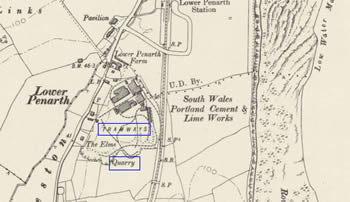
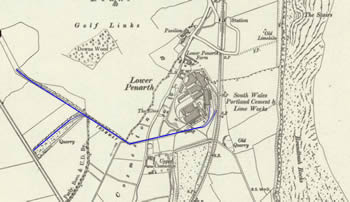
The history of limestone, nearby Lower Penarth, at Lavernock is quite intriguing and the following is based upon the research of Stephen Rowson and Ian L. Wright for their informative books on the history of the Glamorganshire and Aberdare Canals. [528]
Aberthaw was a well known source of limestone from early times and renowned for construction works, since, when burnt in a kiln using anthracite coals imported from further west in the South Wales coalfield, it produced high quality hydraulic lime mortar which is capable of hardening and setting under water. Natural hydraulic lime is a traditional binder produced by burning limestone containing clay (6-25%), which sets given a combination of chemical reaction with water (hydraulic setting) and carbonation (where carbon dioxide reacts with the calcium hydroxides to form solids of calcium carbonate which adds strength).
The beach at Lavernock, consisting of Jurassic limestone cliffs and rocky shoreline platforms otherwise known as the Lower Lias, also yielded stone with similar characteristics and was much sort after by the bridge builders, canal and weir constructors and for mortar for the construction of Penarth Dock, etc., etc. Limestone is a sedimentary rock created by layers of the skeletons and shells of sea creatures which died in ancient seas, settled on the seabed, were compressed by subsequent layers, and thus, over eons hardened, forming into dense, horizontal layers, of limestone.
For the builders of the Glamorganshire Canal (Thomas Dadford) and even earlier, 'Cardiff Lime' was known for its hydraulic and structural capabilities. Lime burning in kilns was a common feature at the seaward end of the River Taff and in 1774, the Melingriffith Tin and Iron Works of Whitchurch, North of Cardiff, was buying lime from Thomas Williams of Town Quay, a local lime-burner. The following year it is recorded that the company leased a kiln from the Corporation of Cardiff at 6p per week to process limestone picked from the beach and cliffs at Lavernock (just below the South Wales Portland Cement & Lime Works referenced above) and brought to the River Taff wharfs by coasting vessels.
The company records for the period indicate that the Radyr Weir which was needed to supply water to power the water-wheels of the works as well as navigation for boats was built utilising this hydraulic lime to bond the blocks of local Pennant stone. This was some two decades prior to the building of the Glamorganshire Canal for which this hydraulic lime was used throughout.
|