Penarth Dock, South Wales - 150 years - the heritage and legacy  
Penarth Dock, South Wales - the heritage & legacy . . .

Volume Thirteen - Pre-Victorian to the Present Day - 'Ellenbank' - and her visit to Penarth Dock in 1885 . . . .

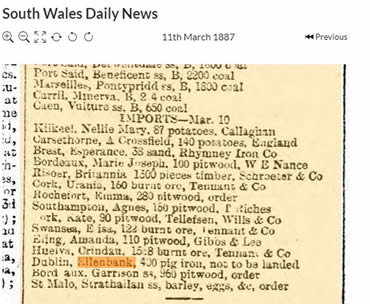
I was intrigued when I found another reference to the ship 'Ellenbank' being at the East Bute Dock at Cardiff on the 10th March 1887 loaded with a 'cargo' of 400 tons of pig-iron and the instruction 'not to be landed.'

I was intrigued when I found another reference to the ship 'Ellenbank' being at the East Bute Dock at Cardiff on the 10th March 1887 loaded with a 'cargo' of 400 tons of pig-iron and with the instruction 'not to be landed.'

She had apparently arrived from Dublin and was working for Tennant & Co. (probably Charles Tennant & Company Limited whom were originally from Glasgow but commenced activities in Dublin during 1810).

Since South Wales was a producer of pig-iron and steels I wondered why the cargo of pig-iron should have arrived and listed under the 'Imports' within the South Wales Daily News newspaper to Cardiff Docks?

Further she was 'Entered Outwards' also on the 10th March 1887. - South Wales Daily News [325] [361] 11th March 1887.

Firstly, we must bear in mind that the vessel was a three masted sailing 'ship' built when iron and/or steel-hulled steam-ships were, at least at Penarth Dock, being out-numbered and out-sized in comparison to sailing vessels within the maritime industry. The building of sailing vessels declined at Ritson's yard at Maryport shortly after the 'Ellenbank' launch due to the need to send vessels to the Clyde or Tyne etc., to be fitted with steam driven elements including engines and boilers because there was no local expertise and industrial infrastructure.

Further research (and using AI [AIX] ) provided the following outputs which have been summarised and I concluded that it was most likely that : -

  • The pig-iron had probably originated from Cumbria and that it made commercial sense that it wasn't intended for sale in South Wales.
  • The 400 tons of pig-iron was ballast or through cargo and was almost certainly cargo remaining aboard while she was being loaded with coal, hence, not to be landed!
  • By 1887 she was commanded by Captain John Briscoe.
  • She was probably loaded with 2,000–3,000 tons of Welsh steam coal over the pig-iron at the bottom of the hold.
  • She perhaps sailed back to Dublin with her cargo of coal for use within the chemical works of Tennant & Co., which would strongly support the conclusion that the pig iron was retained on board as ballast or less likely, through cargo, rather than intended for the Cardiff market.
© 2014 - 2026 - penarth-dock.org.uk - all rights reserved - web design by Dai the Rat