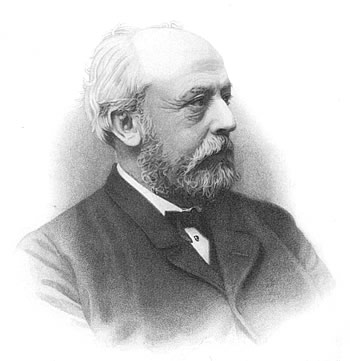
1890 Obituary of Thomas Andrew Walker :
Thomas Andrew Walker was born in 1828. After a brief course of engineering instruction at King’s College, London, he, at the age of seventeen, began his professional career on various surveys, executed in the feverish times of the railway mania.
On the bursting of that bubble he had to abandon his intention of becoming a civil engineer, and was fortunate enough to obtain an appointment under Mr. Brassey, who was carrying out the contract for the North Staffordshire Railway. He remained in Mr. Brassey’s employ until 1854, being engaged on the Royston and Hitchin, the Newcastle and Ashbourne, and, for the last two years of the time, on the Grand Trunk Railway of Canada.
Mr. Walker then began contracting on his own account, and remained in Canada for a further period of seven years constructing railways for the Government of the Lower Provinces.
He returned home in 1861, after an absence of nine years, and reverted to engineering, as an assistant of P. Pritchard Baly, for whom he made the survey of the Orel and Vitepsk Railway, in Russia.
He next went to Egypt for Charles Manby, and during 1864 and 1865 made extensive railway surveys in that country and in the Soudan, where he reached as far as Metammeh, 100 miles north of Khartoum.
On his return to England Mr. Walker was offered, and accepted, the management of the contracts for the extension of the Metropolitan Railway and the construction of the Metropolitan District Line. These works, among the heaviest in modern engineering, had been undertaken jointly by Peto and Betts, Mr. Kelk, and Waring Brothers.
For the associated firms, Mr. Walker supervised the whole of the contracts from Edgware Road to the Mansion House, the works near the latter station being carried on day and night, in order to ensure their completion by the 1st of July, 1871.
From this time until his death Mr. Walker was continuously engaged on his own account (at first in partnership with his brother, the late Charles Walker, and, since that gentleman’s death, alone), in the execution of engineering contracts of the most important character. In this way he undertook the extension of the East London Railway, from the northern end of the Thames Tunnel to its junction with the Great Eastern line at Shoreditch. This part of the line is carried under the London Docks, and entailed very heavy works in the densely populated districts of Wapping, Shadwell, and Whitechapel. The Engineer-in-chief of this work was Sir John Hawkshaw, F.R.S., Past President Inst. C.E., and the connection thus initiated formed an important epoch in Mr. Walker’s career.
For Sir John Hawkshaw he appears to have entertained the profoundest admiration and respect, amounting almost to reverence, and this eminent engineer must have been thoroughly satisfied with the way in which Mr. Walker fulfilled his obligations; for, when the doubtful and difficult work of the Severn Tunnel had reached the final stage of preparation, Sir John chose Mr. Walker to carry out his designs. Mr. Walker regarded the Severn Tunnel as the most arduous undertaking in which he had been concerned. Of this work he wrote an account, the preface of which has been largely consulted in the preparation of this notice. In it he says, 'Subaqueous tunnels have recently become quite the fashion. One such experience as the Severn Tunnel, with its ever-varying and. strangely contorted strata, and the dangers from floods above and floods below, has been sufficient for me. One sub-aqueous tunnel is quite enough for a lifetime.'
Other great works of which Mr. Walker undertook the construction were the Barry Dock and Railways, the Preston Dock, the great Government Docks at Buenos Ayres, and, last but not least, the Manchester Ship Canal. It is, of course, too early to speak of results as regards this formidable work.
It will suffice to say that Mr. Walker’s lamented death will not, as far as can be foreseen, delay the execution of the contract, as he had made all the necessary arrangements for its completion, in the event of his death, by his executors and staff of agents. In popular estimation, the construction of the Manchester Ship Canal, probably, would have been considered Mr. Walker’s magnus opus, although he appears to have been more proud of the Severn Tunnel. But the wonderful concentration of plant and labour on the Canal, and the energy and vigour with which the works are being carried on are better calculated to impress the non-professional mind than the more difficult and dangerous operations carried on beneath both land and water, and so out of sight. . . . continued . . .