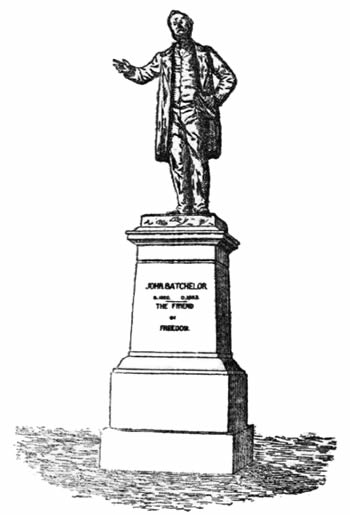
Prior to 1850 the function of attending to the sanitary state of the town was discharged by a body of residents called commissioners, of whom Mr Batchelor became one. Amongst his work in this capacity must be included the introduction of a deep drainage system for the town. Mr John Batchelor, as a Liberal and a Nonconformist, felt dissatisfied with the representation of Cardiff by a Tory, when Mr J. D. Nicholl sat for the borough, and invited Mr Walter Coffin to seek the suffrages of the people at the general election of 1852. Mr Coffin was returned, to the great discomfiture of what was then known as the " Castle party," who bad reckoned confidently on the re-election of Mr Nicholl. The happy change in the political representation of the town was almost entirely due to Mr John Batchelor's perseverance and popularity. The Castle party had enormous influence in the town, and the action of Mr Batchelor raised up around him many enemies. Whilst the course which he adopted was the first step the political enfranchisement of the borough, it was the commencement of Mr Batchelor's downfall, the first check to his prosperity, the turn in the road that ultimately led to his ruin. Mr Batchelor was elected Mayor in 1853, and while engaged in discharging the duties of his high office at the police-court, a Bute representative served him with notice to quit the ground which be occupied at the docks.
Mr John Batchelor formed the project of constructing a dock with a tidal harbour at Penarth. The Bute interest opposed the construction of this dock with all the power at command, but the legislature saw the advantage of competition, and the Penarth Harbour Dock and Railway Bill was passed in 1856. The railway was connected with the main system of the Taff Vale Company, over which the Penarth Harbour and Dock Company bad running powers. This step on the part of Mr Batchelor increased the feeling of animosity between him and the Bute trustees, and the latter having such a monopoly at Cardiff, Mr Batchelor bad to suffer in various ways, sometimes finding it necessary to seek redress in courts of law.
The interest which the deceased took in the development of the commercial prosperity of Cardiff was seen in the care which he exercised in 1873 in preparing plans for dock extension at Cardiff plans which would have been of the greatest advantage had they been carried out. Mr Batchelor's scheme was to utilise the beds of the rivers Taff and Ely, and to enclose within a solid embankment, in the form of a horseshoe, the estuaries formed by these rivers. This scheme would have brought into existence a harbour trust, the desirability of which afterwards became more and more apparent, again proving Mr Batchelor's foresight. It would also have utilised and turned to advantage a large area of mud land, and provided dock accommodation for the next fifty years, however rapidly the coal trade might have been developed. It would also have provided means for establishing an import trade, which all admitted then, and all admit now is so much required.
Political motives again interfered, however, and the Bute trustees would not accept a scheme from one to whom they had been so long hostile. In 1873 circumstances occurred which rendered it necessary that Messrs Batchelor should dispose of the Mount Stuart Graving Dock and Yard, which they had taken upon their tenancy at the West Dock closing. Consequently an application was made to the Bute trustees for permission to transfer the lease of the yard, &c., to a company, every guarantee being given that the works should be carried on. The application, however, was refused. The works, &c., were then sold to Messrs Laughland and Gunn for £ 21,000. Mr Gunn carried them on for some time, and then, with the full consent of the Bute trustees, sold the works to a company for £ 100,000.
What was refused Mr Batchelor made the fortune of his successor. With this failure, after years of struggling against adverse circumstances, Mr Batchelor retired into private life, still strongly adhering to his principles. He was not an old man, but the continued mental irritation to which he had been so long subjected caused him to appear much older than be really was. The mind was as vigorous as ever, but be had become physically enfeebled. His commercial life was at an end, and we have only to look upon him now as the active exponent of Liberal and Nonconformist principles. His work on behalf of Colonel Stuart on the occasion of the election of 1857, was of the most indefatigable and valuable nature. Colonel Stuart was a good man, but not an orator. Mr Batchelor was a fluent speaker, and he followed the Colonel everywhere, and with such good effect that he was returned unopposed at that and several subsequent elections.
Upon the formation of the Cardiff Liberal Association, Mr Batchelor was unanimously elected president. On his retirement from business be went to live at Penarth, and in 1873, when the Education Department required that a School Board should be formed in that district be was elected by a large majority, and then chosen as chairman. This position he held till 1883, when failing health compelled him to resign his seat. In 1874 a School Board was formed at Cardiff, and Mr Batchelor was here also elected a member, and subsequently chosen by themselves as their chair man. Mr Batchelor so managed the affairs of the board that when he resigned the position of chairman in the early part of 1883, there was a general expression of regret from all parties.
In October, 1873, a meeting was held at the Town Hall, Cardiff, when it was resolved to raise a sum of £ 4,000 to be presented to him in recognition of his service to the Liberal party for more than 25 years. In July, 1873, Mr Batchelor was presented with a beautifully illuminated address, and a banker's draft for £ 3,700, the result of the subscription lists which had been opened. Towards this amount the working men of Cardiff contributed about £ 80.
The above are only a few of the leading incidents of Mr Batchelor's life. His efforts in connection with the formation and support of a mechanics' institution at Cardiff, and his strong opposition to the compulsory imposition of church rates, may also be noted. What Mr Batchelor did in connection with the Cardiff Liberal Association, and his active zeal in fighting the battles of the great Liberal party at every municipal election, will be remembered by many. When be died it was felt that the town had lost one of its best men, one who sacrificed himself for the good of others, one who through life held aloft the banner on which the word " Principle " was inscribed, and who,amid the storms and struggles of a career filled with more than ordinary vicissitudes, clung to his banner till death compelled him to release it.