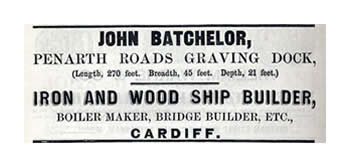
above left - An advertisement for John Batchelor, Penarth Roads Graving dock, Iron and Wood Ship Builder, Boiler Maker, Bridge Builder, etc., Cardiff - from the 1871 Post Office Directory. [626]
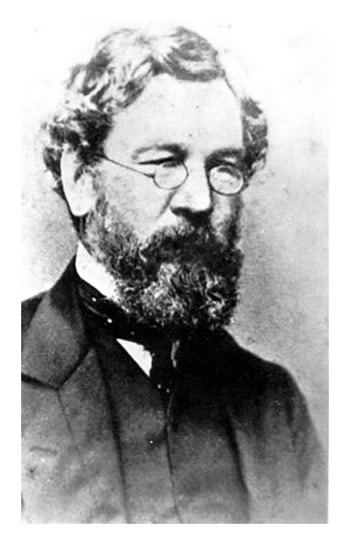
left - 'Statue of John Batchelor, The Hayes, Cardiff, c. 1890's' - from the Cardiff Central Library photographic collection. [405]
The Banker's Magazine [552] of January 1872 had the rather sad entry under 'Mercantile Suspensions' - The following suspensions were announced during the month of March (1871) : 'Mr. J. Batchelor, shipbuilder, Cardiff and Penarth.'
The Law of Slander and Libel [553] [449] of 1891 had the following entry : Indictment for a Libel on a Dead Man. - 'The jurors for our Lord the King, upon their oath, present that before committing of the offense hereinafter mentioned, to wit, on the 29th day of May, 1883, John Batchelor, of Penarth, in the county of Glamorgan, died, and that Thomas Henry Ensor, being a person of an evil and wicked mind, wickedly, maliciously and unlawfully designing and intending to injure and defame the character, reputation and memory of the said John Batchelor, and to vilify and to throw scandal upon his family and posterity, and to bring them into public contempt and infamy, and to stir up the hatred and ill-will of the subjects of our Lord the King against them, and to deprive them of their good name, fame and reputation, and to provoke them to a breach of the peace, on the 23rd day of July, 1886, wilfully, maliciously and unlawfully did write and publish, and cause and procure to be printed and published, of and concerning the said John Batchelor, his family and posterity, the false, scandalous, malicious and defamatory words following, that is to say : "Suggested epitaph for the Batchelor statue" [here copy the libel verbatim], to the scandal and reproach of the name and memory of the said John Batchelor, to the great damage and disgrace of his family and posterity, to the evil example of all others in the like case offending, and against the peace of our said Lord the King, his crown and dignity.'
In the case of R. v. Ensor, 3 Times L. 11. 366, four of the counts ran thus: — "A false, scandalous, and defamatory libel, having a tendency to cause a breach of the peace, and which on the 27th day of July 1886, did cause a certain breach of the peace, to wit, an assault by one Cyril Batchelor and one Llewellyn Batchelor upon one Henry Lascelles Carr at Cardiff, in the county of Glamorgan, in the form of a letter or newspaper paragraph delivered and read by the said T. H. Ensor to John Henry Taylor, James Harris, Henry Lascelles Carr, and divers other persons at Cardiff aforesaid, according to the tenor and effect following, that is to say." These words were inserted because in that case an assault had actually followed the libel ; but they are not essential to an indictment for such an offence. Where there has been no assault the defendant is still criminally liable if there be other evidence of a criminal intent.
The background to the above is that when John Batchelor's statue was erected in 1883 some suggested an alternative to 'Friend of Freedom'. One Cardiff solicitor, Thomas Ensor, wrote to the Western Mail offering : “Traitor to the Crown . . hater of the clergy . . sincerely mourned by unpaid creditors . . died a demagogue and pauper.” When the editor of the Western Mail, Lascelles Carr, published the letter he was prosecuted for criminal libel as described above. The judge, however, declared “the dead have no rights and suffer no wrongs” and ordered the jury to find in favour of the defendants. Our story ends when Lascelles Carr was met by John Batchelor’s sons at Cardiff station and received more than a few bruises for his troubles!
left - John Batchelor - 'The Friend of Freedom'. [000] [002]