|
|
Penarth Dock, South Wales - the heritage & legacy . . . |
|
|
Penarth Dock, South Wales - the heritage & legacy . . . |
 |
|||||
 |
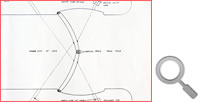
Volume Twelve - Pre-Victorian to the Present Day - further aspects - Report upon Penarth Dock - 1984 . . . Each gate was operated by means of a pair of chains, each attached to a hydraulic hauling engine. The engine used to open a gate worked from the top of the side wall adjoining the gate whilst the chain to close a gate was worked from the side wall opposite the gate, see figure 15 for details.
The use of hydraulic power to open and close the dock gates was somewhat unusual at the time since most dock gates including those at the nearby Bute Docks at Cardiff were worked by hand. 4.1.2 - Floors The floors of both the lock and sea entrance consisted of an invert, two cills, two gate floors and two aprons. The invert of the lock extended for most of its length whilst the invert at the sea entrance was relatively short. The purpose of the invert was to support the side walls and to withstand the upward pressure of water when, in the case of the lock, the lock chamber was empty and in the case of the sea entrance, when the tide was low. The invert was in the form of an inverted arch with a flat bottom. It was probably paved with masonry over most, if not, all it's length. The cills formed raised projections against which the gates closed. The face of the cills making contact with the bottom of the gates were constructed of a particularly hard materials, probably granite ashlar [Ashlar masonry consists of uniformly dressed stones i.e. of common dimensions, shape, and texture]. The rest of the cill was probably paved with masonry. |
||||
| Introduction | |||||
| Contents | |||||
| Search this site | |||||
| Contributions | |||||
| Links | |||||
| Recent Updates | |||||
|
|||||
| | volume 12 | chapter 13 | page 230 | << previous page << | index to volume twelve | >> next page >> | | |||||
|
|||||