|
|
Penarth Dock, South Wales - the heritage & legacy . . . |
|
|
Penarth Dock, South Wales - the heritage & legacy . . . |
 |
|||||
 |
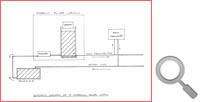
Volume Twelve - Pre-Victorian to the Present Day - further aspects - Report upon Penarth Dock - 1984 . . . Appendix B - Hydraulic Power Hydraulic power in terms of this document refers to the use of high pressure water to power heavy machinery. Though the application of hydraulic power cab be traced back to an early date the pioneer of its use to drive heavy machinery was W. G. Armstrong who invented the hydraulic crane in 1844 and set up a factory in Elswick, Newcastle-upon-Tyne to manufacture hydraulically operated equipment in the late 1840's. The main element of a hydraulic power supply was an accumulator consisting of a tank of water on top of which floated a large weight (80 tons in the case of Penarth Dock). High pressure water was drawn off from the bottom of the tank and piped wherever it was needed. Most equipment used hydraulic rams and even cranes and hauling machinery were operated in this way by using relatively complicated mechanisms to convert linear motion into rotary motion. A hydraulic ram was operated in two stages. Firstly, a valve would be opened to admit high pressure water into the cylinder which would force the ram to be extended. Then this valve would be closed and a second valve opened. The ram would be weighted or attached to an opposing ram which would force the water in the cylinder into a secondary pipe which would return it to a reservoir or storage tank. In this way the system was closed since the accumulator could be filled from the reservoir by means of powerful pumps. An external water supply was only required to compensate for the affects of leaks and evaporation. The use of hydraulic power on a large scale continued up until the 1920's when electrically powered machinery began to be introduced. However, there are still docks which still use hydraulic power for some equipment. [c.1984]
|
||||
| Introduction | |||||
| Contents | |||||
| Search this site | |||||
| Contributions | |||||
| Links | |||||
| Recent Updates | |||||
|
|||||
| | volume 12 | chapter 13 | page 380 | << previous page << | index to volume twelve | >> next page >> | | |||||
|
|||||