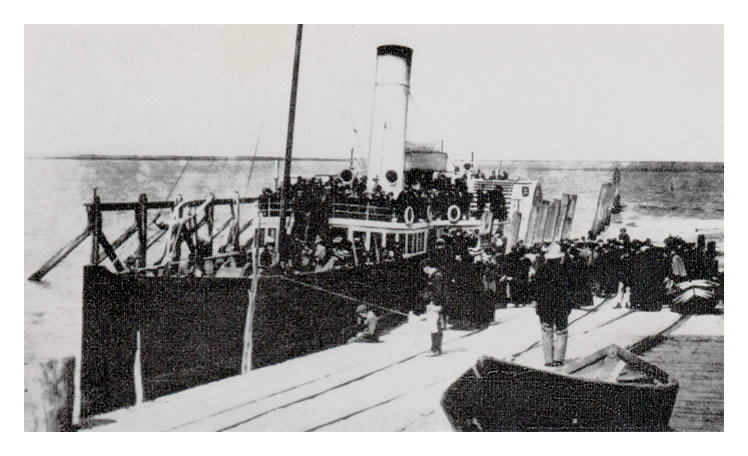
On the Waverley! - by E. B. Dumbleton (Spring 1966) - [1382] - I believe it was August 1914 - World War I had started and the searchlights were in position on Penarth Head. It was a rough day and Campbell's first Waverley (1885, 258 g.t.) was the only paddler which ventured out. We left Cardiff for Weston with about 200 passengers. Capt. Livingstone was in command and all went well until we reached Weston. However, although the ropes were put ashore it proved impossible to make fast. A very heavy sea was running and although, at last, the pier staff managed to pull the ropes onto the pier the steamer could not come alongside so the ropes were allowed to run out.
Waverley was hit by a heavy sea astern which smashed the after end of the top saloon. Alec Everett, the bosun, was holding a door at the end of the saloon. He floated down the top saloon on the door. I was on duty in the dining saloon on the deck below and Mr. H. Rowles, the Chief steward, asked me to keep an eye on things. The tables were laid out with great care and beauty and the carving table held the York Ham and other meats of quality that is rarely experienced today. The sea came through the decks and also into the lower dining saloon, ruining the tables. I had not been expecting this and was taken completely by surprise. Everything presented a sorry sight.
Course was set for Cardiff and I recall seeing the searchlights flashing on Penarth Head. We had to get rid of some of the water from the saloon and an endless human "bucket chain" was devised. The filled buckets were passed from man to man up the lower stairway and put out onto the outer sponson where they were tipped overboard before returned to the lower saloon again.
It was all, perhaps, a very trivial incident, though exciting enough for me at the age of fourteen and a very frustrating experience for the passengers who were thankful for being on dry land again, at last, in Cardiff. The damaged superstructure was covered in canvas and the following morning Waverley returned to Bristol. This was her last trip under the Campbell houseflag for during World War I she was taken over by the Admiralty and used for minesweeping. After the war, in company with her consort Glen Rosa, she was broken up on the banks of the Avon, near the Ashton Bridge. |